99 News SEO Lessons I Learned at NESS 2026


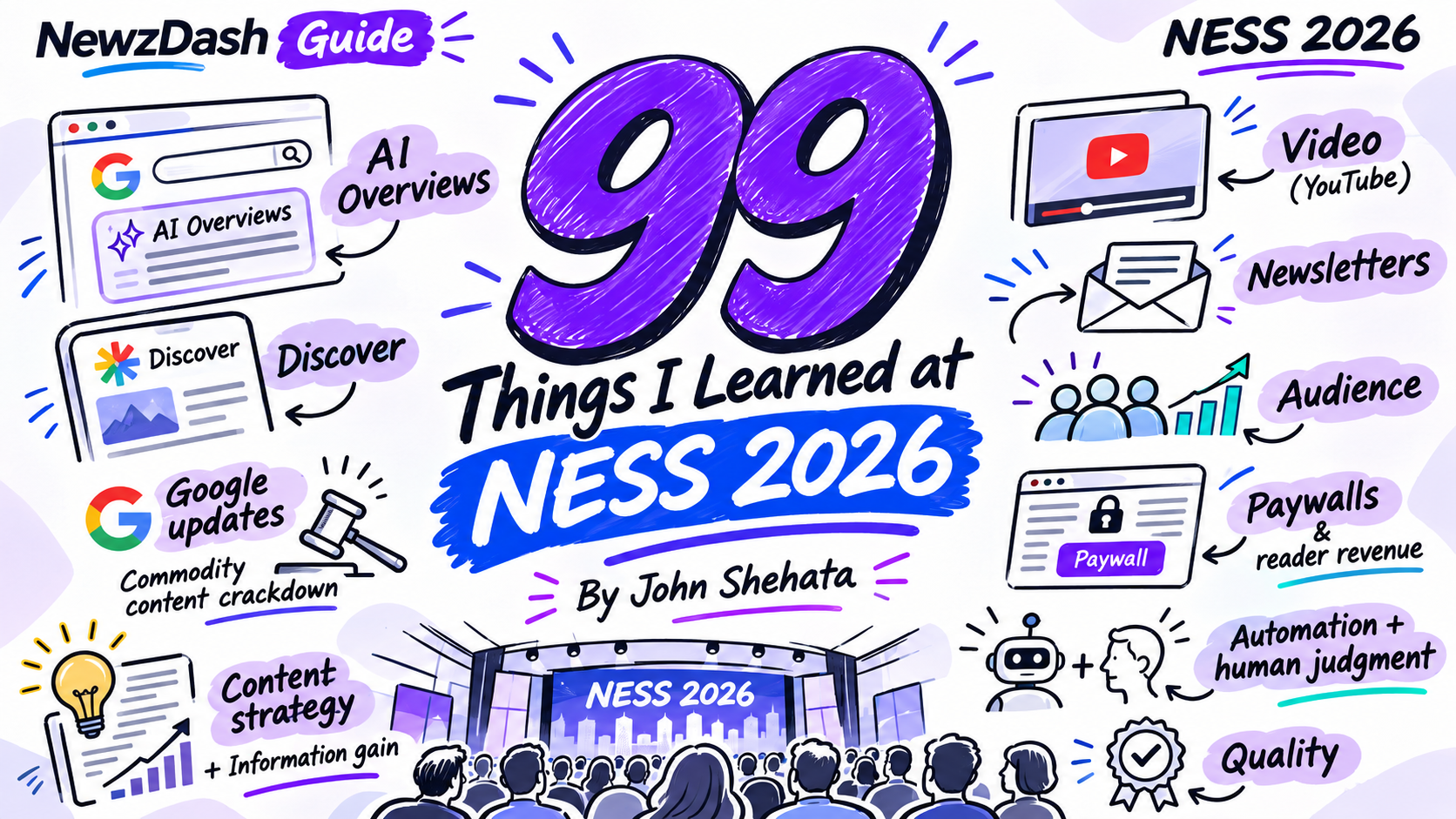
NESS 2026 wrapped on October 15 after three days and more than 20 speakers. Barry Adams and I started NESS five years ago, and this was the year the conversation flipped: nobody debated whether AI would reshape news distribution, and every speaker showed up with numbers and a playbook. I went back through every session and pulled out the 99 most useful things I learned about news SEO and audience growth, grouped by theme, with the speaker named on each one.
TL;DR: AI Overviews are swallowing news search, Discover is crowded and about to change again, Google is punishing commodity content, and the publishers winning are converting reach into relationships: registrations, newsletters, and owned channels. The numbers behind each lesson are below.
Missed NESS 2026? No worries. You can now buy all the session video recordings, speaker presentations included, at newsseo.io/ness2026.
In this article:
- The big picture: own two of the three
- AI Overviews are becoming the new universal search
- Google Discover: crowded, social, and heading agentic
- Google updates and the commodity content crackdown
- Content strategy: consensus vs. information gain
- YouTube and video
- Newsletters, podcasts, and owned audiences
- Paywalls and reader revenue
- Automate the repeatable, keep judgment human
- What I would do this quarter

The big picture: own two of the three
Brian Provost, SVP and General Manager of Yahoo Search, opened the summit, and the closing panel finished the thought.
1. Organic search funded digital publishing for two decades, and that model is being rebuilt in front of us. The real fight now is protecting the open web. (Brian Provost)
2. A publisher can own three things: content quality, monetization, and distribution. "If you can do two of those three things, you're in business. Do one of them, you're under attack." (Brian Provost)
3. Recency is your insurance policy. Brian Provost estimated 20 to 25% of the intent a search engine handles daily depends on freshness, and LLMs do not run foreign bureaus or show up at local events.
4. 15 to 20% of queries every day have never been seen before, which is why fresh reporting keeps its leverage. (Brian Provost)
5. Brand mentions inside AI answers without a funnel are nearly worthless. They matter to your PR team, not your revenue. (Brian Provost)
6. Do not respond to traffic loss by adding more ads. Brian Provost called that "an accelerant to the death spiral."
7. Do not boycott the AI platforms either. Manage the paths from AI surfaces into products and funnels you control. (Brian Provost)
8. GEO exercises the same muscles as foundational technical SEO, and the AI platforms are "maybe a decade behind" in crawling, rendering, and scoring. Get schema and renderability in order now. (Brian Provost)
9. Yahoo teased a rights and licensing mechanism, due within weeks of the event, that would let publishers tell AI crawlers how content may be used and paid for, with models like revenue share on the table. (Brian Provost)
10. "Massive traffic is over. And they have to deal with it." Tell your executives and reset the baselines. (Virginie Clève)
AI Overviews are becoming the new universal search
I presented NewzDash data from the roughly 400 publishers we track, and three other speakers landed on the same trajectory from different data.
11. 62% of US breaking and major trending news searches now trigger an AI Overview, up from roughly 2 to 3% in 2025. (NewzDash)
12. Local news queries sit near 70%, up from 24%. Science and health verticals run as high as 90%-plus. (NewzDash)
13. Top Stories now renders inside the AI Overview in 26% of US news searches, up from 16% a year earlier, and a story appears either inside or outside the box, never both. The full data is in our Top Stories in AI Overviews study.
14. Citations churn fast: six hours after a story breaks, 36% of the sources first cited in the AIO are gone. (NewzDash)
15. Ranking #1 in Top Stories earns an AIO citation only about 60% of the time. (NewzDash)
16. My prediction, on the record: AI Overviews become the new universal search by 2027, absorbing shopping, forums, video carousels, and now Top Stories the way blended search absorbed verticals in 2007.
17. Featured snippets are gone: 0% on MozCast since September 1, replaced by AI Overviews, which now appear in 77% of search results per the data Crystal Carter of Wix shared.
18. Zero-click searches reached about 68% in the US, per the SparkToro and Similarweb panel data Crystal Carter cited.
19. AIO citations shuffle among a stable set of sources rather than regenerating fresh each time, so losing a slot is not necessarily permanent. (Crystal Carter)
20. On a major AI platform, verifying whether news is real and checking the latest updates on a story make up roughly 40 to 50% of all news searches. People use AI to check the news, not just read it. (John Shehata)
21. Google generated an AI Overview on the Kawhi Leonard story The Athletic broke in under eight minutes, and sports AIOs grew more than 590% in nine months. Sports is not the safe vertical anymore. (Claudio Cabrera)
22. Google's new Search Console toggle to exclude content from AI Overviews likely also removes you from Top Stories inside them. One major publisher's 24-to-48-hour test saw total Search Console clicks drop about 20%. Run the test yourself and measure both Search and Discover. (John Shehata)
23. YouTube is the most-cited site in AI Overviews in both the US and UK, more visible than the top ten news publishers combined. What is your YouTube strategy today? (NewzDash)
24. Keep AI referrals in perspective: ChatGPT sends news sites about 44 million visits a month, up 116% in two years, and still under 1% of site traffic. Start measuring with the three layers in our AI visibility tracking guide.
Google Discover: crowded, social, and heading agentic
Nicola Agius, Director of SEO and Discover at Reach PLC, put numbers on what many of us have felt.
25. Discover's share of publishers' total Google traffic fell from about 75% to 62% this year, the first drop we have measured, while Google News tripled from 2% to 6%. (NewzDash)
26. The feed is crowded: since January 2025, UK publishers earning Discover visibility grew 46% and article volume grew 57%, so each viral hit is smaller. (Nicola Agius)
27. Social content is taking slots: over a fifth of the UK feed and 40% of the US feed in September, with X and YouTube the most visible domains in both markets. (Nicola Agius)
28. Combined Discover cards now group dozens, sometimes 100-plus, articles sharing a headline entity behind one primary card, and only the primary publisher gets the impression. (Nicola Agius)
29. The defenses: original reporting and two to three entities per headline, with 90 to 105 characters the optimal length per Lily Ray's research. (via Nicola Agius)
30. "Discover rewards depth, not breadth. Don't try and be a jack of all trades, master of none." Niche sites regularly outperform bigger generalists. (Nicola Agius)
31. The first 24 hours of engagement decide whether Google pushes an article further or buries it, and "an article seen but not clicked may be worse than no article at all." (Damien Andell's research, via Nicola Agius)
32. Discover click-through runs about four times higher than organic search, which is why the channel is worth the volatility. (via Nicola Agius)
33. Images matter: 1,200px-plus, 16:9, colorful pictures of recognizable people doing things. Avoid repeated stock photos, text-heavy images, and logos. (Nicola Agius)
34. Discover drops have many causes beyond you: core updates, seasonality (US entertainment dropped about 80 points late in 2025, then recovered in awards season), NSFW flags, aggressive ads, and poor mobile UX. (Nicola Agius, with Glenn Gabe's ad case studies)
35. Discover is heading agentic: a Google job posting describes it moving from a content feed to an experience that helps users track their goals. Work the channel while it pays and convert spikes into newsletters and registrations. (Maddie Shepherd, CBS)
36. Swapping headlines and URLs too often triggered Discover penalties in Germany. Change URLs only for meaningful updates. (John Shehata)
Google updates and the commodity content crackdown
Glenn Gabe of G-Squared Interactive counted the enforcement wave, and Mark Williams-Cook of AlsoAsked supplied the ground evidence.
37. 2026 has seen four spam updates (March, June, August, September) plus a February Discover core update and broad core updates in March and May. Google is fighting a flood of AI-scaled content. (Glenn Gabe)
38. "Commodity content" is now official Google language, and when Google documents something new, treat it as a warning. (Glenn Gabe)
39. Mt. AI is the pattern for sites scaling low-quality AI content: visibility surges until Google's systems adapt, then collapses. "It works until it doesn't." (Glenn Gabe)
40. When traffic drops, check the update timeline before blaming AI Overviews. Algorithm hits keep getting misdiagnosed as AI losses. (Glenn Gabe)
41. Paid mentions and citations bought for AI search visibility are "the new unnatural links," and Glenn Gabe expects a Penguin-style reckoning for buyers, sellers, and brokers.
42. Deceptive authorship (fake authors, AI-generated headshots, invented credentials) has been added to Google's documentation. (Glenn Gabe)
43. A Google hit now cascades across surfaces: the ten blue links, AI Overviews, AI Mode, Gemini, and ChatGPT when it grounds answers through Google. (Glenn Gabe)
44. Recovery from spam hits is possible but needs sustained change: one month at the fastest he has seen, five months in a documented Lily Ray case. (Glenn Gabe)
45. Quality is more than content: Navboost tracks 13 months of user interaction signals, and Google's new CrUX ad metrics measure ad count, density, and weight. There is a public tool; test your domain. (Glenn Gabe)
46. After an unannounced late-July update, a classification of just under a million pages across hit sites found content outside each site's core topical lane suppressed hardest, with the decay spreading to core pages if unfixed. (Mark Williams-Cook)
47. Scaling is fine with real writers at a maintainable quality bar: 50,000 to 100,000 pages over time is defensible, 5,000 to 1.5 million is not. (Glenn Gabe)
48. A short AI summary on top of a human-reported article is fine. Wholesale AI scaling is what gets hit. (Glenn Gabe)
Content strategy: consensus vs. information gain
Gianluca Fiorelli stood in at the last minute and delivered the most quotable framework of the event.
49. Among the most-cited domains in AI Overviews, YouTube leads at 21%, Reddit takes 18%, Facebook 11%, and no publisher makes the top ten. The top travel site sits at 0.7%. (Gianluca Fiorelli)
50. The two traps: pure consensus content gets absorbed into AI answers and never credited, while pure novelty without credentials gets filtered as unreliable. (Gianluca Fiorelli)
51. "Consensus is your passport. It is not your destination. It gets you into the room. It will never get you cited." (Gianluca Fiorelli)
52. His prescription is a 30/50/20 split: 30% consensus to prove you belong, 50% enhanced consensus with features competitors lack, and 20% pure information gain, assets that exist nowhere else.
53. Rewording consensus in your own tone changes nothing: research he cited found about half of large-scale web training data is removable as semantic duplication. (Gianluca Fiorelli)
54. Invert keyword research: ontology, then taxonomy, then entities, then keywords. "Keywords are the output of the thinking, not the input." (Gianluca Fiorelli)
55. Mine query fan-out across models. Gemini is the only one that labels expansions by intent, data no keyword tool gives you. (Gianluca Fiorelli)
56. Pages that answer upfront get cited roughly 67% more often in his data. And his test for every page: "Strip the brand name from the page. If it could be any competitor's, you have written consensus in a nicer font."
YouTube and video
Phil Nottingham of Organic Video opened Day 3 with the channel most publishers still underinvest in.
57. YouTube is a tortoise game: expect a two-to-three year journey and several hundred videos, with success compounding the way SEO does. (Phil Nottingham)
58. The sobering benchmarks: the average video gets 391 views a month, and only 15% of channels publish more than 100 videos before quitting. (Phil Nottingham)
59. "The thumbnail is the title and the title is the subtitle." A thumbnail click-through under 4% means test a new thumbnail and title, and YouTube has native A/B testing for exactly that. (Phil Nottingham)
60. The 4S model: Suggested, Shorts, Search, Subscribers. Decide which of the four a video is optimizing for before you publish. (Phil Nottingham)
61. Third-party YouTube search volume data is "just worthless." Use median monthly view velocity instead; his free tool at showrunner.net computes it. (Phil Nottingham)
62. View-to-subscriber benchmarks: 1% is okay, 2% means fast growth, 3% is top tier. Do not buy subscribers; it does not work. (Phil Nottingham)
63. Shorts and Reels are trailers for your long-form: visual-first and effectively silent, so captions carry them, you have a three-second hook window, and only about 5% of viewers click through to listen with sound. (Phil Nottingham)
64. Running video on your own player and YouTube at the same time is fine and often preferable, and big news sites can outrank YouTube. Pure AI text-to-video "will get nixed really quick." (Phil Nottingham)
Reddit sent its own Head of News Partnerships, Gabriel Sands, and Mallorie Sullivan of USA TODAY showed what the work looks like in practice.
65. The scale: 440 million weekly active users, over half of America visiting weekly, and 55 billion views on news conversations last year. (Gabriel Sands)
66. "Reddit is a city, not a stage." You participate in it; you do not broadcast at it. (Gabriel Sands, quoting Reddit's CEO)
67. Reddit Pro is free: publisher verification, RSS sync, discovery of where your content is already being shared, and a trends tab for social listening. Publishers adopting it saw a 48% lift in median comments, per Reddit's internal data. (Gabriel Sands)
68. Focus on small-to-medium subreddits, message moderators before posting regularly, and keep a green/yellow/red list of communities. (Gabriel Sands)
69. Posts have roughly 48-hour engagement windows, and always leave a first comment with context: "once the first person gets into the pool, it's much easier for others to follow." (Gabriel Sands)
70. AMAs are the lowest-risk entry because moderators pre-arrange them, and they pay three ways: story ideas, sources, and promotion. One USA TODAY Network AMA on AI denying insurance claims surfaced tips from a software engineer, a health tech professional, and a doctor. (Mallorie Sullivan)
71. The Columbus Dispatch ran the perfect loop: opened a thread on Ohio's measles outbreak, collected the community's questions, took them to doctors, published the answer story, and closed the loop back in the thread. (Mallorie Sullivan)
72. Train reporters to participate as people, on personal accounts; one built karma in a scrapbooking subreddit first. Start with 5 to 10 minutes a day. (Mallorie Sullivan)
73. Expect paywall hate and prepare approved messaging on how subscriptions sustain journalism. Gift links work well; label them clearly. (Mallorie Sullivan and Gabriel Sands)
74. Do not create r/YourBrand; contribute to existing communities instead. The Athletic grew its Reddit presence over 400% in six months of day-to-day management and runs an ambassador program giving superfans free subscriptions to share content. (Gabriel Sands; Claudio Cabrera)
Newsletters, podcasts, and owned audiences
Nick Petrie of The i Paper, podcast strategist Sarah McDowell, and Claudio Cabrera of The Athletic covered the direct-relationship channels.
75. Stop growing lists. Grow relationships. That was Nick Petrie's whole deck title, and it is the right frame for every owned channel.
76. Give every newsletter one job and one success metric: Navigate (referrals), Inbox-value (engagement), or Community (participation). List size, click rate, and unsubscribes are monitored but never targeted. (Nick Petrie)
77. Every launch or relaunch gets a one-pager first: the audience, their need, how the newsletter serves it, and the business purpose. (Nick Petrie)
78. You cannot grow list size, open rate, and click rate at the same time. Agree before launch which number matters, so a dip elsewhere does not cause panic. (Nick Petrie)
79. Judge sign-up sources by downstream behavior: do those readers open in the first 30 days, come back weekly, and take a next action. (Nick Petrie)
80. Open rates are a weak proxy after Apple's privacy changes. A 30% daily open rate might mean the same 30% of people, or 75% of the list across a week. Measure unique weekly engagement. (Nick Petrie)
81. The discipline shows: The i Paper runs 17 newsletters against roughly 80,000 paying subscribers, the flagship daily reaches 78% of the entire list, and the relaunched Money Coach grew its list 19% in September. (Nick Petrie)
82. The Athletic's The Pulse has about 5 million subscribers opening daily at a 50 to 60% open rate, and over 80% never click. That is a relationship, not a failure, and labeling select stories "free to read" lifted clicks 30%. (Claudio Cabrera)
83. Gift links became a product: from about 50,000 visitors a week to ten times that, with repeat recipients hitting a registration wall. "The road to subscription is much healthier when the road is through registration." (Claudio Cabrera)
84. The Athletic's WhatsApp channel went from zero to nearly 700,000 followers in under a year, with weekly reporter drop-ins, and was their best engagement channel during the World Cup. (Claudio Cabrera)
85. Podcast saturation is overstated: of 4.7 million podcasts, only about 10% published anything in the last 90 days. (Sarah McDowell)
86. E-E-A-T works as a podcast growth framework: on-the-ground reporting, expert guests, indexable episode pages with transcripts and show notes, and asking explicitly for follows and reviews. She opened from our 2026 news SEO trends survey, where trust signals ranked second for the year. (Sarah McDowell)
87. The host is the moat: 82% of listeners say the host is a big part of, or the only, reason they listen to their favorite podcast. (via Sarah McDowell)
Paywalls and reader revenue
Ed Hyatt of The Wall Street Journal gave the session I would make every publisher executive watch, and the closing panel sharpened it. For the broader map, see our guide to three diversification strategies for traffic, audience and revenue.
88. "Not all traffic loss is loss." WSJ is losing search traffic like everyone else and still growing subscribers, because much of what disappears is empty calories. (Ed Hyatt)
89. Purposeful Reach, WSJ's in-house metric, weights every traffic source by its propensity to convert a reader into a subscriber. It replaced raw pageview talk in the newsroom. (Ed Hyatt)
90. Discover traffic converts up to 10x worse than organic search in WSJ's data, while AI search is the most intentional search there is. (Ed Hyatt)
91. The paywall tiers: free for commodity news and live coverage, registration wall for analysis and guides, hard paywall for scoops, exclusives, and proprietary data. "You can't afford not to have some kind of registration wall or paywall today." (Ed Hyatt)
92. Get the paywall technicals right: let Googlebot crawl paywalled pages, use isAccessibleForFree: false with hasPart in NewsArticle schema, control snippets, and validate, since common plugins do not handle paywall schema for you. (Ed Hyatt)
93. Aim Google's Preferred Sources at subscriber retention, not acquisition. (Ed Hyatt)
94. The Daily Mail stays calm because about 60% of its audience has always come direct and 60 to 70% of its search traffic was always branded. "We never talk about Discover anymore, like, ever." (Carly Steven)
Automate the repeatable, keep judgment human
Valentin Pletzer of Ippen Digital and Mark Williams-Cook agreed on the principle from different directions. For how these pieces fit the rest of the stack, see our best news SEO tools for 2026.
95. Deterministic workflows beat AI agents for newsroom work, because reader trust is the one asset you cannot put at risk. "AI can help build a workflow. Once reviewed, it runs the same way every time." (Valentin Pletzer)
96. Use AI as one node inside a deterministic workflow, never as the whole process. AI proposes, a human decides. His example n8n workflows, from hourly news sitemap monitoring to PageSpeed checks, are importable from github.com/VorticonCmdr/ness2026. (Valentin Pletzer)
97. Local models are production-ready: running open models through Ollama on a single graphics card classified just under a million pages in about a day, work that frontier-model APIs would have billed thousands of dollars for. (Mark Williams-Cook)
98. Fine-tuning beats API calls for repeat jobs: a small model trained on 4.8 million queries now replicates Google's eight semantic query classes, free at queryclassifier.com, deterministic and instant. (Mark Williams-Cook)
99. The panel's career advice for the AI era: keep an agile brain, learn agentic coding, carry projects to 90% and let go of what stopped working, and identify your biggest internal critic and take them to lunch. Stay curious; the people behind these 99 items certainly are.
What I would do this quarter
If you lead SEO or audience at a news publisher, this is the checklist I took out of our own event:
- Reset traffic baselines with your executives now. The declines are structural, not a dip, and planning against 2024 numbers wastes a quarter.
- Pick your two of three. Decide where you can credibly own content quality, monetization, and distribution, and invest there.
- Measure your AI Overview exposure. Know how many of your top queries trigger AIOs and whether you are cited inside them.
- Convert Discover spikes into owned audiences. Newsletters and registrations first, while the channel still pays.
- Stand up one off-SERP channel with a 12-month runway: YouTube, Reddit, or WhatsApp, with a named owner and a repeatable format.
- Automate one manual monitoring task with a deterministic workflow this month.
Missed NESS 2026? No worries. You can now buy all the session video recordings, speaker presentations included, at newsseo.io/ness2026.