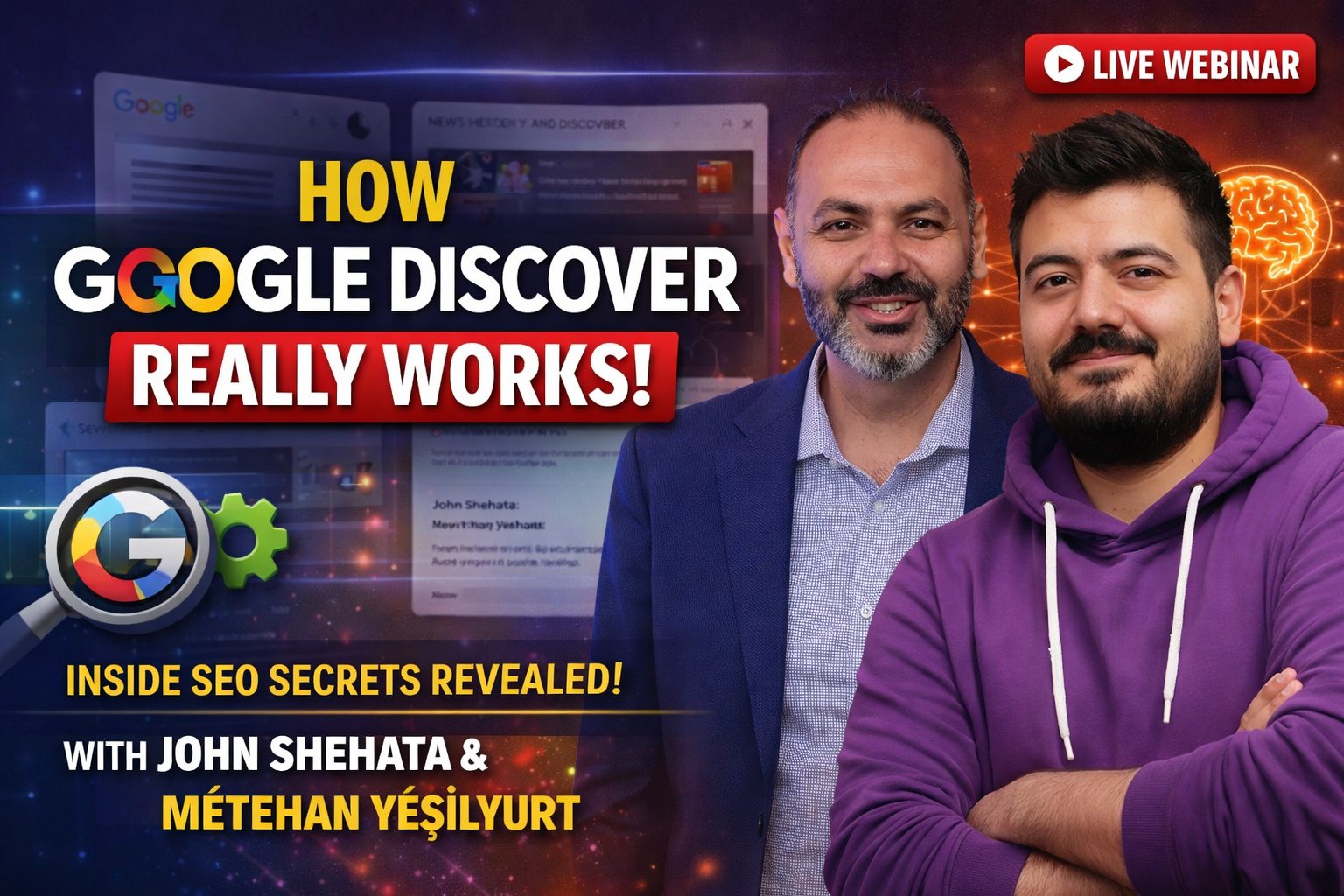
𝐆𝐨𝐨𝐠𝐥𝐞 𝐃𝐢𝐬𝐜𝐨𝐯𝐞𝐫 𝟗-𝐒𝐭𝐞𝐩 𝐂𝐨𝐧𝐭𝐞𝐧𝐭 𝐏𝐢𝐩𝐞𝐥𝐢𝐧𝐞, 𝐃𝐞𝐜𝐨𝐝𝐞𝐝 - with Metehan Yeşilyurt and John Shehata - webinar video recording


Google Discover is not a single algorithm, it is a pipeline.
Live Webinar FAQ: Metehan Yeşilyurt on how Google Discover really works
We just wrapped a live webinar with Metehan Yeşilyurt on the 9-step Google Discover content pipeline.
The webinar is based on Metehan's latest investigative work on hoe Google Discover content pipeline works. See the full chart here.
Full Webinar Video:
Q: What got you into SEO, and why Google Discover?
Metehan: “I started my SEO experiments in early 2010. I was in high school. I thought if I published a new website, everyone would be notified about it and they would come. Of course, that was not the case. That was the moment I met SEO.”
“I’ve been in SEO professionally for more than a decade. I started at an agency in Turkey, then worked at one of the biggest news outlets in Turkey during the pandemic. After that, I worked in a mobile user acquisition company, then co-founded AI Vision, where we help brands. My current focus is AI search.”
“I’m familiar with Google Discover from my time in the news industry. The actual reason I dug into this again was after the summit in Dubai. I met great publishers and news outlets, not only from the Middle East but also from Germany. I had a chance to discuss Discover deeply with them.”
“Another reason is that traffic is tanking. Because of all the new AI search stuff, not only from ChatGPT or other LLMs, but also because informational queries are losing clicks. We are living in zero-click behavior right now. So I wanted to dig in.”
Q: How did you analyze Google Discover?
Metehan: “I mostly start by trying to open black boxes in the search industry.”
“I love listening to browser events. Recently it has helped a lot for understanding LLMs and Google. Then I switched my perspective: can I listen to my phone events? So I plugged in the USB and started listening.”
“I won’t expose the exact methodology because it’s a little complicated. But what you can apply for yourself is this: first, you can start listening to your phones and apps through a USB connection to your PC. There are many tools for that.”
“My main findings are coming from the Google Search app on your mobile phone.”
“iPhone doesn’t provide too much information. The easiest way is analyzing app files on Android. But I don’t mean you will learn everything from that, because my findings are coming from listening to client-side events. We still don’t know the exact Google Discover algorithm, because weights and parameters are happening on Google’s server side.”
Q: What are telemetry patterns?
Metehan: “You can collect many events, just like Google Analytics. But telemetry events work differently. There are technical elements like WebSocket connections you can identify.”
“In Chrome or Firefox, you can right-click, inspect, then go to the network tab. You can see different connections from WebSockets, fetch events, JavaScript files, CSS files, and others. Telemetry is a different technical way of communication.”
“If you read some articles about it, especially with help from LLMs like ChatGPT or Claude, you can understand it more easily.”
Q: What happens in the first stage, content ingestion?
Metehan: “I believe Google has different crawlers for each content type. I recently started a new experiment and I see Google using other user agents a lot, not only Googlebot. We know Google has different user agents for ads, for news, and even for Gemini Deep Research.”
“It starts with crawling. I believe the only official way to interact with Google right now is your sitemap through Google Search Console. For news publishers, there are also other official channels like News Management and Publisher Center. Crawl is where it starts.”
“If you are already running a major news website, Google consistently crawls your website. If you share your links on social and drive traffic from other channels, you are likely to be crawled as soon as possible and then indexed by Google.”
Q: What are the biggest failure points at the ingestion stage?
Metehan: “First, images are essential. You have to use a proper image in your schema tag or Open Graph tags. Using a high-quality image based on Google guidelines is essential after crawling.”
“Then, based on my findings, knowledge graph entities. I will mention this a lot. And WH questions, like which, how, what, when. You need to use those properly.”
“Google first needs to match user interests with an article. On the client side, I can confidently say Google is collecting knowledge graph entities.”
Q: Why are entities so important in Discover?
Metehan: “Everything Google collects is also used to deliver fresh news in Discover. If you use knowledge graph entities properly, Google can merge them with a user’s history.”
“I had an interesting case last year. I visited the UK. Before that, I looked for visa information because I needed it. Then I traveled to London and later planned a route to Cambridge. A few days later, I saw Cambridge featured in my Google Discover feed with recent UK visa news. So everything Google collects is used to deliver fresh news in Discover.”
“If you use rich and relevant entities, Google can better match your article with personal interests.”
Q: Did you see signs of content classifiers?
Metehan: “Yes. I realized there were some cluster names in my phone. I’m very confident Google has different cluster types for different content types.”
“In my findings, I saw cluster names like Neon cluster, Geo targeting stories, Deep trends, Fresh videos, Must and miss, Homestack, Trending UGC. Very interesting names.”
“Then Google updated its guidelines for Discover and decided to include Open Graph image in the documentation. They also announced they would deliver more UGC content in Discover feeds. So UGC is essential.”
“I also see a lot of X in my Discover feed. YouTube is essential too. Google is collecting your YouTube history and engagement events. I’m not saying I know every exact engagement event they collect, but they are collecting YouTube engagement events on the client side. And YouTube has a shared infrastructure with other search products. Based on my findings, Google is using this shared infrastructure for Discover as well.”
Q: What happens in URL parsing and page extraction?
Metehan: “Google wants to deliver more content in our Discover feeds. That means it is creating fallback mechanisms for Discover post titles, news titles, images, and maybe AI-generated descriptions or summaries.”
“Based on my findings, Google is trying to deliver more predicted content to our mobile devices at the moment. So they created that fallback mechanism.”
“Sometimes Google wants to change headlines using schema tags and Open Graph tags. I published a blog post with a live example from my Discover feed where Google actually used the Open Graph title instead of the actual article title. That was very interesting.”
“This is essential if we want to run A/B testing for Discover. Schema and Open Graph tags are probably the best ways to do that. We can see which titles are appearing in Discover.”
Q: Does Google always use the Open Graph title first?
Metehan: “Here comes the predictive part. Google is using predictive CTR, especially in ads, and I believe they apply a similar approach in Search and Discover because they use shared infrastructure.”
“For the rewrite, I believe it depends on every user and it depends on alignment with personalization. If Google thinks one title will get more clicks, it may prefer that version.”
“Google is also running experiments on Discover. Maybe they used schema titles more last year. Maybe this year they want to use Open Graph titles more. Maybe two years later they want to use actual titles more.”
“What I can say is this: Google has alternatives to pick from. There is a fallback mechanism, and there is a predictive mechanism. So it is essential to use alternative headlines in your schema.”
Q: What about content classification, like breaking news vs evergreen?
Metehan: “These classification labels are coming from a personal device, so they may be different for other people. My interests are different from yours. Google may create many classification groups and test them.”
“What I can say is that Google Discover is working in an amazing way because it is predictive and it is trying to deliver news before you search. This is one of Google’s main goals right now, especially with AI.”
“Google Discover has a rug-pull mechanism. This part is interesting. Based on my findings, I think Google is sending articles to our mobile devices in advance. Then, if my interests suddenly change, those waiting articles can be reversed back and replaced with articles related to my new interests.”
“Everything you are interacting with across Google products, Maps, YouTube, direct Chrome visits, and more, is feeding the classification system for your personal interests and embeddings on Google servers.”
Q: Does Google prefer publishers focused on one vertical?
Metehan: “Based on my experience and findings, Google loves it if you are publishing in one focused vertical.”
“I’m not saying Google will hate you if you publish in multiple verticals. That’s not the case. But if you are running a major news outlet and consistently publishing breaking news, then suddenly your content team starts publishing more tabloid content, that might send different signals.”
“You can check the recency periods of every vertical and identify the signals you are sending to Google.”
Q: Can an ecommerce or non-news site get Discover traffic?
Metehan: “Yes. I had an interesting case. We were working with a Turkish ecommerce site focused only on pet accessories. We weren’t publishing in a news format much, mostly targeting long-tail transactional queries in the blog.”
“Then I wanted to run a test, and for Nowruz we started to get Discover traffic from that ecommerce website in Turkey. I was very happy. We’re still trying to get more Discover traffic. Of course, it’s not easy because we also need to compete with news websites and niche publishers. But it showed it is possible.”
Q: What is the collection gate, and why does it matter?
Metehan: “The blocking and gate mechanism lives inside your mobile device at the moment. That part is confirmed. Google also has different endpoints for collecting these events, which is very interesting.”
“If you get enough negative feedback or blocks, it might cause your entire domain, maybe for an uncertain period, to lose Discover traffic. We don’t know the exact server-side configuration, but Google collects these events on the client side.”
“At the user level, it is normal that people may not want to see a website in their Discover feed. But if enough of those signals accumulate, it might affect performance more broadly. This is the speculative part, because I cannot access the server-side configuration.”
“Still, the certain part is this: Google is collecting those blocking events on the client side with different endpoints.”
Q: How does matching work between content and user interests?
Metehan: “If you are using proper knowledge graph entities in your headlines, descriptions, and at the beginning of your article, it will help a lot to send positive signals to Google.”
“Just think in reverse. In Google Search, users type something. In Discover, they don’t need to search for anything. It works in a predictive way. The easiest way to match user interests is by using knowledge graph entities.”
“If Google can collect enough knowledge graph entities from your devices and other Google products, it can deliver better Discover content to users.”
Q: What do we know about the server side?
Metehan: “It looks like a great machine. Google is trying to hide many things, but it leaves many clues on our devices. You can predict what is happening at user scale.”
“Google is running a large amount of A/B testing and assigning experiment numbers to each user. It is also happening in Google Search, YouTube, and other Google products.”
“I wish I could access the server side. It’s not possible.”
Q: Why does predictive CTR matter so much?
Metehan: “The core formulation for predictive CTR lives in the ad side, and also I believe in YouTube. Somehow Google figured out that it also works in Search and Discover.”
“There are even six types of prediction formulations working inside Chrome-based browsers at the device level, which is super interesting.”
“Google is working very fast for everything, typing, collecting data, and predicting behavior. If you use only a clickbait headline like, ‘If you did this, you will feel bad,’ there are tons of examples showing that it doesn’t work long term.”
“Google is very good at predicting CTR for news titles and Discover titles. If you use longer headlines, you can include multiple entities, and that probably works better for user interests and user intent.”
Q: How important is the feedback loop?
Metehan: “The three dots in the Discover feed are very important. If you click them, you will see entities, and sometimes Google asks questions during your feed, like whether something is useful or not.”
“It is the same in YouTube feeds, shorts, and other content. I believe this is very essential for understanding user interests better.”
“The feedback part is the hardest thing, making everyone happy with your article and with the engagement on your website. It is super hard to satisfy every reader and every user. But the feedback loop is essential, and Google is collecting that feedback.”
Q: What are the top things publishers should focus on right now?
Metehan: “First, fallback mechanisms. Google is trying to deliver every indexed content item into Discover, maybe using the actual headline, maybe using schema. Google updated its documentation and is telling us that it first checks schema tags, then Open Graph tags, and tries to deliver the best-performing headline for CTR.”
“Please use proper images and avoid clickbait or anything like that, because Google works very well at understanding whether a headline will get clicks or if it is clickbait-ish.”
“Second, entities. Use rich and relevant entities in your content, whether you are publishing breaking news, evergreen, blog posts, or any other category.”
“Third, freshness. We are all already aware of freshness. Please try to publish with proper entities, in time, just in time.”
“And consider updating your articles and URLs carefully.”
Q: What about changing URLs in Discover?
Metehan: “You need to align with your technical configuration. You need to update your sitemap at the same time. Sending signals at the same time is essential based on my experience.”
“It is another black box, but if you abuse Google enough, you will be penalized for that.”
Q: Which historical CTR matters in the predictive model?
Metehan: “I think the historical CTR part is also aligning with Google Search performance. But it is obvious that Google is collecting CTR events from Discover itself.”
“If we compare predictive CTR and historical CTR, I believe Google is probably checking your historical performance and comparing it with your current headlines, then deciding what to deliver into a user’s Discover feed.”
“If I say too much more about how they compare those two, that would probably become speculation. But it is obvious Google is using both metrics and trying to collect every event possible from your Discover feed.”
Q: Can podcasts perform in Discover?
Metehan: “This is a great question. If YouTube is appearing a lot in Discover, maybe you can use other channels and Google products to become more visible in Discover.”
“Google is aggressively collecting YouTube events. Maybe if you are doing podcasts, you should also consider starting a newsletter on Substack. We see that a lot recently in news appearance. Using other channels for your podcast will probably help with Discover, but it needs to be tested.”
Q: If a website wants to break into another vertical, what should it do?
Metehan: “Sometimes we think only from one-domain perspective. Please use other channels. If YouTube is appearing a lot, test it. Maybe you need to create some teams, maybe you don’t have budget, but what I can say is that it needs to match your current audience interests and intent.”
“Maybe test your X account, because we see a lot of UGC in Discover. Run some tests and try to understand whether you are getting more views.”
“Don’t think only from a single-domain perspective. Try to send more signals, more aggressively. Adjust your content calendar, align with freshness, and try to send more signals from your website and all your other channels to Google.”
Q: How important is technical timing, like sitemap pings and cache behavior?
Metehan: “Sometimes websites use heavy cache systems and they don’t actually ping Google at the right time with their sitemaps, which is very essential. Please check whether it is updating at the same time, a few seconds later, or not. Many people skip this issue.”
“Notifying Google at the right time is essential. Period.”
Q: How do you expand from one local area to a wider audience in Discover?
Metehan: “Probably your competitors are already talking with more entities and they have more actual CTR and predictive CTR for that area. It will take time.”
“If you constantly publish more content, you will probably have a chance for Discover testing. Google sometimes tests new websites in the Discover feed.”
“But I believe it won’t happen in the same week or two weeks later. You probably need to publish more content and send more signals for the areas where you want to be visible in Google Discover.”
Q: How important is location for Discover?
Metehan: “I see patterns where websites from India or other Asian regions sometimes get more Discover traffic than publishers originally based in the United States.”
“Google also updated its guidelines. I’m not saying if Google says something, that means it works exactly that way, because it’s Google. But probably using semantic text in your HTML and using schema tags are helpful for geographic targeting.”
“I don’t think Google is only checking hosting or server location. Also check where your visitors are coming from in Google Analytics. I believe that helps Google identify the geographic audience of the website and decide where to show it in Discover.”
Final takeaway
Metehan: “Google Discover is predictive. It is trying to deliver content before you search. And the easiest way to help Google understand and match your content is through entities, freshness, proper images, strong fallback metadata, and the right technical signals.”
“Google is collecting much more feedback and behavior data than most people realize. The client side gives us many clues, even if the full server side remains hidden.”