2026 News SEO Trends & Predictions: Insights From 20 Global Experts On What’s Next


Introduction
Last year we worried about AI. This year we’re living it: fewer clicks, more zero-click experiences, and visibility now happens across multiple surfaces, not just rankings.
2025 felt like the panic year. In 2026, the real work starts: adapting workflows, redefining what “success” looks like, and building a visibility strategy that holds up even when the SERP becomes an answer engine. This is no longer a single-channel game.
“Search, Discover, video, and AI answers are not separate channels anymore, they’re different doors into the same building. If your trust signals crack in one, you feel it everywhere.” — John Shehata
Because the truth is, publishers are not only competing in Google Search anymore. Visibility is splitting across Search, Discover, YouTube, social platforms, and AI answers. The winners will be the teams that connect the dots across these surfaces, strengthen their brand and entity signals, and measure outcomes beyond pageviews.
To understand what’s coming next, we asked 20 News SEO leaders the same set of questions about 2026: the biggest changes in Google, the impact of AI Overviews and AI Mode, whether publishers should optimize for LLMs, how Discover fits in, what to do with evergreen content, and the top priorities for the year. Below is the consensus, where experts agree, and where they strongly disagree.
Best Regards,
John Shehata
P.S. If you read one section, read this: Key Takeaways (At a Glance)
Methodology
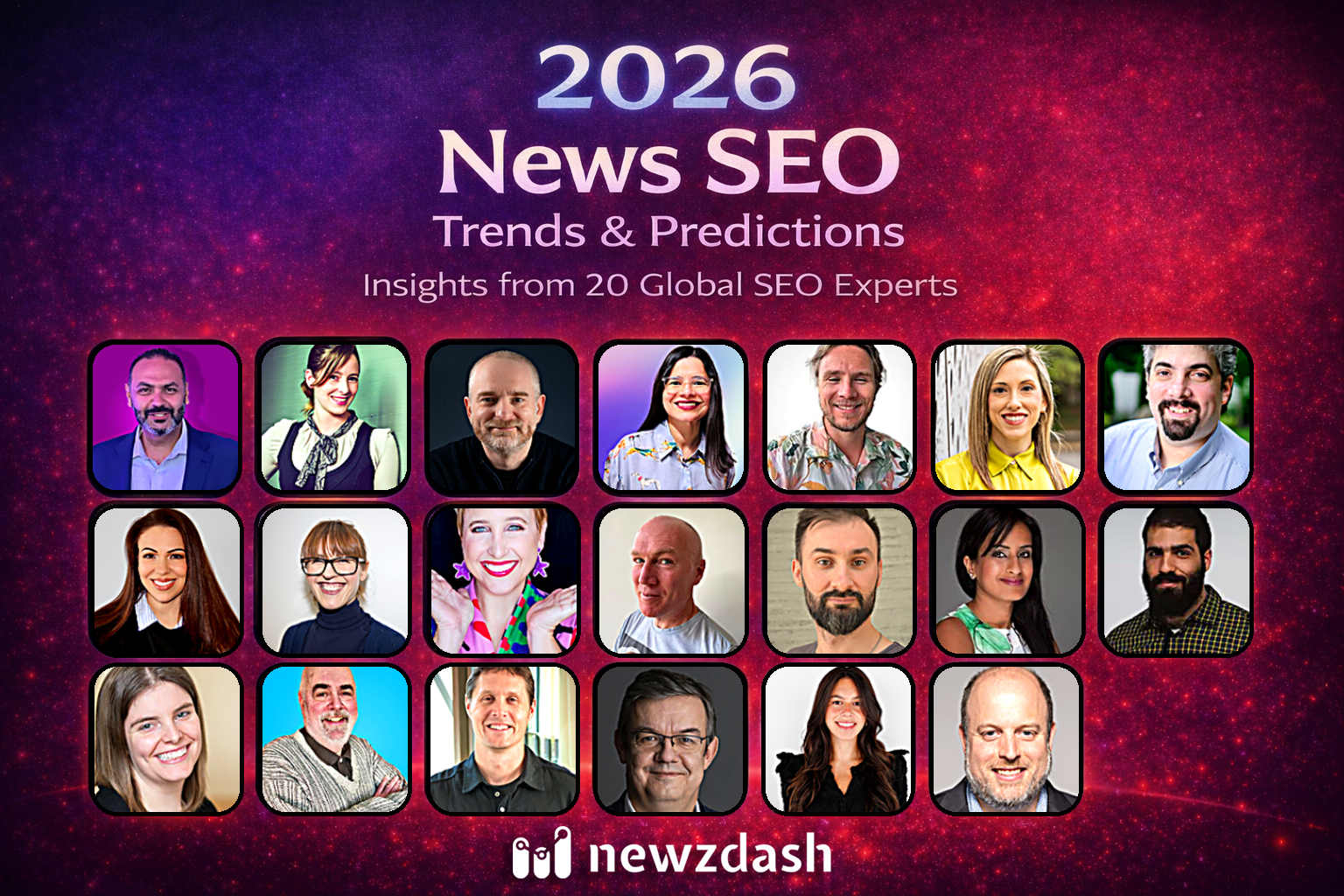
This article is based on input from 20 News SEO leaders. The SEO and News SEO experts completed the same survey (these responses power the charts and percentages), plus my own perspective that I added across all sections.
Who participated
A mix of in-house SEO leaders at publishers and platforms, along with agency and independent consultants working directly with news organizations across multiple regions. The 20 experts are a diverse group of experts across countries, languages, seniorities, specialties, content focus, etc.
Thanks again to all the experts who contributed to this report. If you’d like to be included in the 2027 edition, reach out and we’ll add you to the list.
- Aleyda Solis: SEO Consultant and Founder, Orainti
- Alli Berry: SEO Director, MarketWise (former Sr. Director at Arena Group))
- Barry Adams: SEO Consultant, Polemic Digital
- Barry Schwartz: SEO News Editor, Search Engine Land
- Binti Pawa: VP, Audience Growth & Development, Forbes
- Carly Steven: Director of SEO and Editorial Ecommerce, Daily Mail
- Clara Soteras: Freelance Consultant (former SEO Director at ElNacional)
- Emily Schwartzberg: Senior Product Manager, SEO, Dow Jones
- Greg Jarboe: President and co-founder, SEO-PR
- Harry Clarkson-Bennett: SEO Director, The Telegraph
- Jes Scholz: Growth Marketing Consultant (former CMO at Ringier AG)
- John Shehata: CEO, Founder, NewzDash (former Global VP of Audience, Conde Nast)
- Justin Bank: Founder, The Independent Journalism Atlas (former Washington Post, NPR)
- Louisa Frahm: SEO Director , ESPN
- Marshall Simmonds: Founder, Define Media Group, Inc.
- Mateusz Mikos: Co-founder, FratreSEO (former Ringier Axel Springer Polska)
- Nicola Agius: SEO and Discover Director , Reach PLC
- Philippe YONNET: CEO - Neper Consulting, NEPER
- Steven Wilson-Beales: SEO & Content Strategy Consultant (former Global)
- Vahe Arabian: Founder, State of Digital Publishing
Questions we asked
We asked experts to share their 2026 predictions and priorities across the topics that are reshaping news visibility right now, including:
- AI Overviews and AI Mode impact
- Whether publishers should optimize for LLMs, and how
- Google Discover volatility and whether it’s still a top priority
- Traffic and revenue diversification beyond Google
- Brand, authorship, entities, and E-E-A-T
- Evergreen content strategy in an AI-driven world
- The biggest Google changes and the biggest challenges facing News SEO teams
How we synthesized the answers
We first summarized the responses into a set of key themes and consensus points (with supporting quotes), then included the full expert predictions below so you can read each perspective in context.
Table of Content (clickable)
- Key Takeaways (At a Glance)
- Top 10 Key Findings for News SEO in 2026
- Biggest Changes in Google to Prepare For
- The AI Reality: AI Overviews and AI Mode Impact
- Should Publishers Optimize for LLMs, and How?
- Are LLMs a Threat to Publisher Traffic?
- Should LLMs Pay Publishers?
- Google Discover in 2026: Priority or Liability?
- Video as the New Search Engine
- Brand Authority, E-E-A-T, Entities, and Authors
- Beyond Google: Diversification and Business Models
- Evergreen Content in 2026: Keep, Change, or Reduce?
- Biggest Challenges Facing News SEO Teams
- Meet the Experts: Full Predictions (Q&A)
1) Key Takeaways: TL;DR
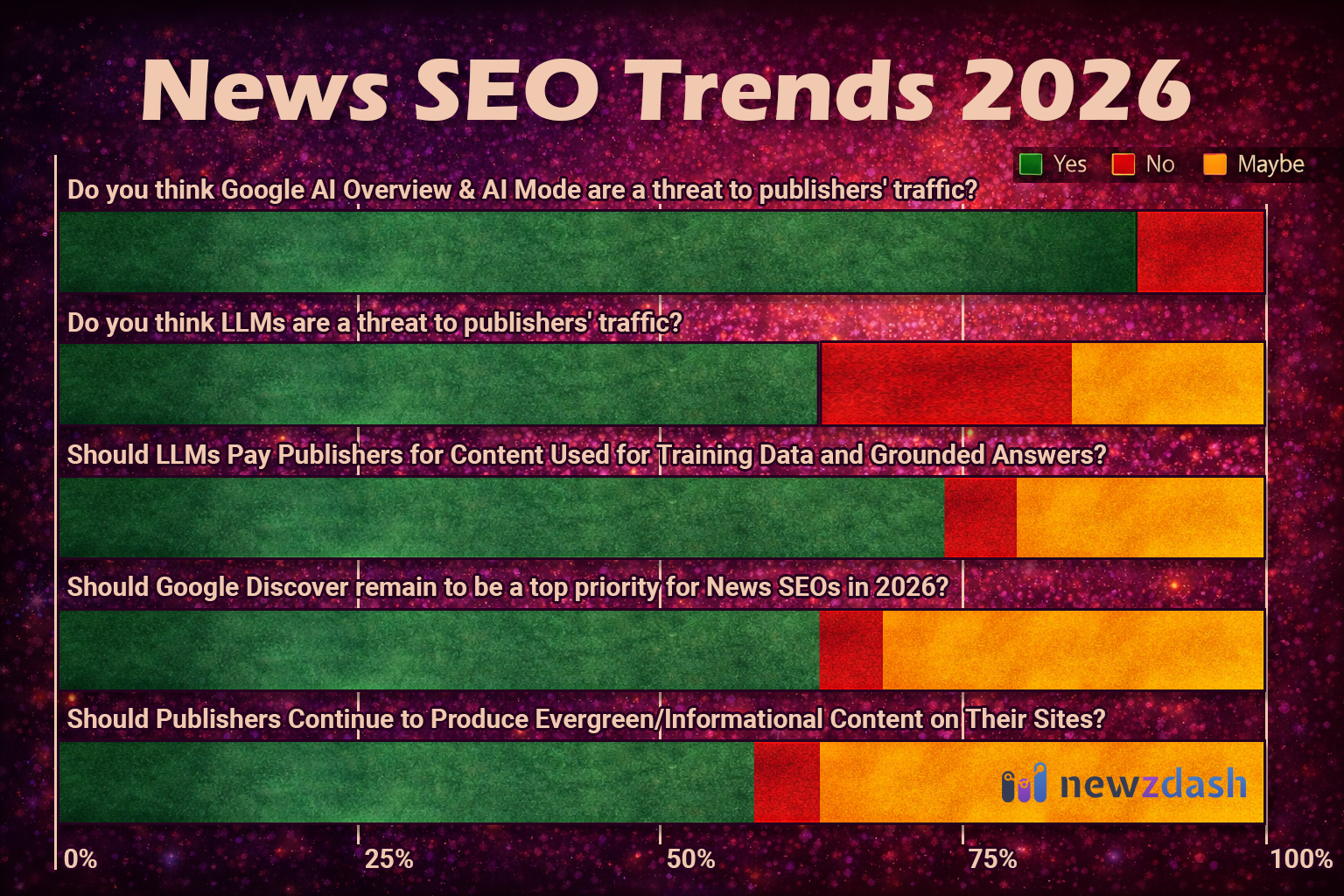
Survey snapshot (quick stats)
Based on 20 survey responses. These results power the charts and percentages:
- AI Overviews + AI Mode as a traffic threat: Yes (89%), Maybe (11%)
- LLMs as a traffic threat: Yes (63%), No (21%), Maybe (16%)
- LLMs should pay publishers: Yes (74%), Maybe (21%), No (5%)
- Should Discover remain a top priority? Yes (63%), Maybe (32%), No (5%)
- Should publishers keep investing in evergreen? Yes (58%), Maybe (37%), No (5%)
Top priorities for 2026 (ranked by votes)
When we asked respondents to choose their top priorities for 2026, this is what rose to the top:
- Traffic diversification beyond Google: (58%)
- E-E-A-T and trust signals: (47%)
- Topical and entity-driven SEO: (42%)
- Google Discover strategy: (42%)
- Optimizing for AI/LLMs: (26%)
- Technical SEO fundamentals: (26%)
- AI Overview optimization: (26%)
What this tells us: 2026 is less about chasing one algorithm tweak, and more about building durable visibility across multiple surfaces, backed by trust, clear entities, and a plan that does not depend on a single traffic source.

5-point recap
1. AI Overviews and AI Mode are already changing the click economy. Visibility is rising, clicks are shrinking, and source selection matters more than ever.
2. LLMs are a real opportunity, and a real risk. The industry is divided, but the smart approach is preparation without obsession.
3. Discover is still powerful, but it is not a foundation. Discover is "High Reward, High Risk." Experts call over-reliance a "deadly danger." Treat Discover traffic as a windfall to be invested, but never budget your newsroom's survival on it.
Ignoring Search for Discover is like trading a foundation for fireworks: enjoy the burst, study what sparked it, reinvest the gains, but don’t build a castle on sand without the true foundation, Search.— John Shehata
4. Brand, authors, entities, and E-E-A-T are the moat. Trust is now infrastructure, and it compounds across every surface.
5. Diversification is no longer a “growth project”, it is risk management. The winners will build channels that compound, not channels that distract.
What to do next week
- Audit your exposure: Identify the top 20 pages and topics most vulnerable to AI answers and zero-click behavior.
- Fix the basics that impact trust: Author pages, About pages, editorial standards, and core schema consistency.
- Create a “citability” checklist: Clear ledes, strong sourcing, quotable lines, and scannable structure on key templates.
- Pick one diversification bet: Commit to one channel that compounds (newsletter, YouTube, app, partnerships) and set a 90-day plan.
- Update your KPI board: Keep pageviews, but add engagement and value metrics (return rate, depth, conversions, LTV where possible).
If you do only 5 things in Q1 2026
A practical starter plan based on the patterns across expert answers:
- Stop treating Google as one channel. Build one workflow that covers Search, Discover, video, and AI visibility.
- Strengthen your “why you.” Tighten authorship, About pages, expertise signals, and entity clarity across your top topics.
- Diversify on purpose, not randomly. Pick 1–2 non-Google channels you can win in (YouTube, newsletters, app, partnerships) and commit.
- Make content easier to cite, and harder to summarize. Lead with unique reporting, original data, strong sourcing, and clear structure.
- Update your scorecard. Keep visits, but add metrics that reflect quality and value (return rate, engagement depth, conversions, LTV where possible).
Additional Resources
If you want to go deeper, here are a few NewzDash resources that can help you turn these insights into action:
- Google Discover: Learn how Discover behaves, what drives performance, and how to reduce volatility risk. Explore resources
- AI Overviews tracking: Understand how AI Overviews are appearing across topics, and where they’re impacting visibility and clicks. Learn more
- Newsletter: Get weekly News SEO and AI visibility updates, trends, and practical playbooks. Subscribe
- Book a demo: If you want to measure visibility across Search, Discover, and AI surfaces in one workflow, request a NewzDash demo.
2) Top 10 key findings for News SEO in 2026

Based on the survey results, the stats above, and the written responses from experts, a few clear patterns stand out. Some confirm what many teams already feel in their day-to-day work. Others point to shifts that are still underestimated.
Here are the 10 biggest takeaways shaping News SEO in 2026.
-
AI Overviews and AI Mode are already impacting traffic
This is no longer theoretical. Nearly 9 out of 10 experts see AI Overviews and AI Mode as a direct traffic threat. The concern is not just fewer clicks, but fewer predictable clicks, especially on explanatory, evergreen, and mid-funnel queries.
What this means: Publishers need to monitor AI Overview frequency for trending news queries, and measure the impact on traffic.
-
LLMs MAY be becoming another traffic competitor, not just a tool
Two-thirds of experts believe LLMs pose a traffic risk, while a meaningful minority does not. That split matters. It shows the industry is still divided on whether LLMs will replace discovery or simply reshape it.
What this means: Teams should prepare for LLM visibility without betting the business on it.
-
There is broad agreement that LLMs should compensate publishers
More than 70 percent of respondents believe publishers should be paid when LLMs use their content. This reflects a growing expectation that attribution alone is not enough.
What this means: Licensing, partnerships, and compensation models will become strategic conversations, not legal side notes.
-
Google Discover is still a priority, but trust is fragile
A clear majority still considers Discover a top priority, but the large “Maybe” segment tells the real story. Discover can drive massive volume, but volatility has forced teams to be more cautious.
What this means: Discover is powerful, but dangerous when treated as a single growth lever.
-
Evergreen content is being re-evaluated, not abandoned
Most experts still support investing in evergreen content, but very few are doing it the same way as before. AI answers have changed which evergreen topics are worth the effort.
What this means: Evergreen must be harder to summarize and easier to differentiate.
-
Traffic diversification is the number one priority for 2026
When asked to pick top priorities, diversification beyond Google ranked first. This includes video, newsletters, apps, partnerships, and alternative discovery surfaces.
What this means: Relying on one platform is no longer a defensible strategy.
-
E-E-A-T and trust signals remain foundational
Despite all the AI noise, trust did not drop in importance. In fact, many experts see brand, authorship, and credibility as the main defense against commoditized AI summaries.
What this means: Strong brands and clear expertise compound across Search, Discover, and AI surfaces.
-
Topic depth and entity clarity are replacing keyword-first SEO
Topical authority and entity-driven coverage ranked higher than technical SEO and AI Overview optimization. This signals a shift from page-level tactics to site-level credibility.
What this means: Winning in 2026 is about owning topics, not just ranking URLs.
-
Metrics are changing, even if dashboards have not caught up
Several experts highlighted the need to move beyond pageviews toward engagement, return rate, and value-based metrics. AI-driven discovery makes raw traffic less reliable as a success signal.
What this means: Teams need new scorecards that reflect quality, not just volume.
-
News SEO is becoming an operating system, not a channel
The biggest underlying theme is structural. SEO is no longer just about optimizing content after publication. It now influences editorial planning, distribution, measurement, and even business models.
What this means: The most successful teams will integrate SEO into every stage of the newsroom workflow.
3) Biggest changes in Google to prepare for

The biggest shift heading into 2026 is not a single feature or update, it’s Google evolving its role. Google is no longer just a traffic router, it is also an answer and selection engine, reshaping what gets surfaced, which sources are chosen, and where clicks still happen.
Here are the Google changes News SEO teams should be actively preparing for in 2026.
-
Google is selecting sources, not just ranking pages
Between AI Overviews, AI Mode, Discover modules, and publisher panels, Google is increasingly deciding which sources are trusted enough to be featured, summarized, or cited.
What to prepare for: Brand strength, author credibility, and topical authority matter more than incremental ranking gains.
"The shift from click-based to citation-based search means publishers must become sources Google has to name, not just summarize." — Marshall Simmonds
-
AI Mode is changing the search journey
AI Mode introduces multi-step, conversational search journeys where users may never return to the traditional results page for evergreen, task-oriented, and information queries. In many cases, Google answers the question before a click is even possible.
What to prepare for: Content needs to be structured to be referenced, cited, or followed up on, not just clicked.
"The big one is going to be the evolution of AI Mode... AI visibility optimisation is going to lead more, hence why you should be swatting up on this stuff now." — Steven Wilson-Beales
-
AI Overviews continue to expand into more query types
AI Overviews are no longer limited to basic informational queries. They are expanding into explainers, evergreen topics, and areas that historically drove consistent traffic.
➠ Check our analysis on AI Overview Impact on News.What to prepare for: Expect more zero-click outcomes, especially for commodity explanations and mid-funnel content.
-
Discover remains powerful, but less predictable
Google Discover is still one of the largest traffic drivers for publishers, but volatility continues to increase. Sudden drops or spikes are becoming more common. Maintaining your status in Search will maintain your Google Discover stability.
What to prepare for: Treat Discover as an accelerator, not a foundation, and build safeguards through diversification.
-
Trust and Originality signals are getting stronger
Google continues to emphasize original reporting, firsthand experience, and clear sourcing. This trend shows up across Search, Discover, and AI-driven surfaces.
What to prepare for: Thin aggregation and lightly rewritten content will struggle to compete for visibility.
-
Entity understanding is becoming central to visibility
Google’s systems rely heavily on entity relationships to understand who is authoritative on what. This influences rankings, Discover eligibility, and AI citations.
What to prepare for: Clear topic ownership, consistent coverage, and strong internal linking matter more than isolated page optimizations.
-
Personalization is increasing, even if it’s subtle
Search, Discover, and recommendation systems are becoming more personalized based on user behavior, interests, and past engagement.
What to prepare for: Performance will vary more by audience segment, not just by keyword.
-
Technical SEO is table stakes, not a growth lever
Technical SEO still matters, but it is no longer a differentiator on its own. Fast, crawlable, well-structured sites are expected, not rewarded.
What to prepare for: Technical excellence enables visibility, but it won’t create it by itself.
-
Measurement inside Google is getting harder
AI answers, Discover surfaces, and new interfaces make it harder to clearly attribute visibility and clicks using traditional tools alone. Specialized SEO tools for news - AKA newzDash - becomes a must to measure brand's visibility in all Google Surfaces for trending news queries.
What to prepare for: Teams will need to combine Search Console, Discover data, analytics, and qualitative signals to understand performance.
-
Google is pushing publishers to think beyond clicks
Across all these changes, the underlying message is consistent: visibility, influence, and brand presence matter, even when clicks decline.
What to prepare for: Success in 2026 will be defined by being chosen and trusted, not just ranked.
4) The AI reality: AI Overviews and AI Mode impact on newsrooms
This is not one feature, it’s a new interface. AI Overviews and AI Mode are changing how users discover news, how Google selects sources, and how often a “search” ends without a click.

The concern is real: 89% of News SEO experts expect AI Overviews and AI Mode will impact publisher traffic in 2026 - NewzDash survey.
What’s changing inside the newsroom
-
Traffic patterns are becoming less predictable
AI answers compress the journey. A lot of queries that used to send steady evergreen traffic may now end at the top of the SERP. When clicks do happen, they often shift toward deeper intent, stronger brands, and stories with something genuinely new.
Implication: Plan for fewer “guaranteed clicks” and more volatility across evergreen query types.
-
Headlines needs to work harder
If Google is summarizing the story, the packaging matters even more. Strong headlines, clear angles, and fast context can influence whether you get cited, selected, or ignored.
Implication: The goal is not only to earn the click, it’s to be selected as a source.
➠ Check Headline Optimization.
"The title and the square image need to grab the user's interest to the point they will click to read more... It must give the user a reason to click beyond the commodity content." — Jes Scholz
-
Editorial planning shifts toward “unique and citeable” content
Commodity explainers and lightly differentiated coverage are easier to summarize. Original reporting, strong opinions, exclusive details, primary sources, unique data, and strong expert quotes are harder to replace.
Implication: More focus on distinct angles and “why us” coverage decisions.
"Stories need to be sexy to sell... Straighter stories are on the way out. Explainers need a rebrand." — Harry Clarkson-Bennett
-
Evergreen strategy changes (and gets more selective)
Evergreen content still matters, but the bar is higher. If the topic can be answered in a short AI summary, that page needs a stronger value proposition: tools, data, firsthand experience, or depth that AI can’t match.
Implication: Fewer evergreen pages, higher quality, and a stronger refresh discipline.
-
Measurement and KPIs need to evolve beyond pageviews
Pageviews still matter for many publishers, but they are becoming a weaker signal of visibility. Teams are starting to care more about citations, brand presence, engagement, return rate, and conversions.
Implication: Build a scorecard that reflects influence and value, not just volume.
-
Search Console and analytics won’t tell the full story
AI-driven discovery makes attribution harder. Visibility can happen without a click, and clicks may come later through follow-up journeys that are difficult to track with traditional reporting alone.
Implication: Combine multiple data sources and accept that measurement will be fuzzier.
-
Distribution becomes multi-surface by default
If Google is answering more queries directly, publishers need stronger presence in Discover, video platforms, newsletters, apps, and communities. This is not a “nice-to-have” anymore, it’s a hedge.
Implication: Editorial and SEO teams need a shared cross-platform plan.
-
The "French Exception" (Geography Matters)
While AI Overviews are saturating US and UK results, the reality is different in highly regulated markets.
-
The Insight: Philippe Yonnet notes that in France, "neither AI Overviews nor AI mode have been deployed" due to the strict interpretation of the Digital Markets Act (DMA).
-
The Takeaway: For global publishers, 2026 will be a split-screen reality. You may need aggressive AI optimization for US audiences while maintaining traditional SEO structures for EU markets where regulators are blocking Google’s AI features.
-
Newsroom playbook: what to change now
- Briefs: Add a “why us” requirement. What is unique, exclusive, or genuinely helpful about this story? Include target entities, primary sources, and the one sentence you want others to cite.
- Headlines: Prioritize clarity and angle. Make the value obvious fast, and avoid generic phrasing that blends in with everyone else.
- Schema: Tighten the basics (Article/NewsArticle), strengthen author and organization signals, and ensure dates, canonical URLs, and key entities are consistent across templates.
- Refresh cadence: Create a refresh trigger list (breaking updates, new numbers, new official statements, new context). Update with visible “What changed” notes when appropriate.
- On-page structure: Lead with context, then deliver the new information. Use scannable sections, clear subheads, and quoteable lines. Make it easy for both humans and machines to extract the story accurately.
- Measurement: Track visibility plus value: engagement depth, return rate, conversions, newsletter signups, and any proxy for influence or brand lift.
5) Should publishers optimize for LLMs, and how?
This question created the sharpest division in our survey. While 79% of experts believe publishers should optimize for LLMs (either fully or experimentally), a vocal minority argues that doing so is a strategic error.
The industry is split into two distinct camps: those who view LLMs as a new visibility surface to be managed, and those who view them as a competitor to be starved.
The Argument Against: "Don't Feed the Replacement"
- Not everyone agrees that optimizing for AI is the right move. Barry Adams provides the strongest counter-argument, warning that publishers are helping accelerate their own decline.
- For this group, resources are better spent on channels that drive direct engagement (Newsletters, Apps, Search) rather than improving the quality of a system designed to answer queries without a click.
- Clara Soteras and Nicola Agius both cite that LLMs currently drive only 0.2% of publisher traffic on average.
"No. LLMs do not drive traffic, so traffic-dependent organisations like news websites would be foolish to optimise for a channel that intends to replace them entirely." — Barry Adams
"If your primary KPI is pageviews, then the answer is no — LLMs currently drive only around 0.2%... Bing should be a higher priority." — Nicola Agius
The Argument For: "Optimization is Brand Survival"
- The majority of experts argue that LLMs will answer questions with or without you. The only choice is whether your brand is cited as the source, or if you are invisible.
"If you ignore LLMs, you are effectively invisible to the user’s personal assistant... We are not optimizing for clicks—we are optimizing for Attribution." — Mateusz Mikos
- Greg Jarboe and Steven Wilson-Beales echo this, noting that as search behavior shifts toward agents, being part of the "knowledge base" is essential for brand authority, even if the referral traffic is lower than traditional search.

What “LLM optimization” actually means for publishers
For those committed to LLM optimization, the advice has moved beyond "good content" into specific technical and structural changes.
- Clarity over cleverness. LLMs favor content that is well-structured, clearly written, and unambiguous. Strong ledes, explicit context, and clean sectioning help machines and humans alike.
- Entity-first thinking. Clear entities, people, organizations, locations, and topics make it easier for LLMs to understand who you are authoritative about and when to reference you.
- Originality still wins. LLMs are better at summarizing consensus than surfacing new information. Original reporting, exclusive data, firsthand experience, and primary sources remain the hardest things to replace.
- Consistency across surfaces. Author bios, About pages, topical hubs, and structured data should tell the same story everywhere. Mixed signals weaken trust, for users and machines.
- Content that is easy to cite. Clear statements, strong sourcing, and quotable lines increase the chance that your work is referenced accurately inside AI answers.
- "Data-First" Architecture for Agents LLMs and agents struggle with heavy JavaScript, complex DOM structures, and interstitials.
- The Fix: Ensure your most valuable data (prices, facts, entities) is accessible in the raw HTML or structured data, not locked behind client-side rendering.
- Expert Insight: "Don't force the AI to scrape your visual website... Provide a 'Data-First' architecture." (Mateusz Mikos)
- Structure for "Zero-Shot" Attribution LLMs hallucinate when information is vague. To get cited, you must be definitive.
- The Fix: Use unambiguous formatting. Bullet points, data tables, and direct "Answer" paragraphs (the inverted pyramid style) make it easier for models to extract facts accurately.
- Expert Insight: "Techniques like straightforward formatting, FAQ style structuring, bullet points, and lists can make information easier to cite." (Louisa Frahm)
- Entity Clarity is the New Keyword Strategy LLMs function on entity relationships, not keyword matching. They need to know who you are and what you are an expert in.
- The Fix: Strengthen Author and Organization schema. Ensure your "About" page and author bios clearly define your expertise areas so models associate your brand with specific topics.
- Optimized "Chunking" AI models often process content in chunks rather than reading a full article linearly.
- The Fix: Ensure every section of an article can stand alone semantically. A paragraph ripped out of context should still make sense and contain the necessary entities to be attributed back to you.
What LLM optimization should not become
- Chasing prompt hacks or speculative ranking factors
- Publishing content primarily for bots instead of readers
- Removing paywalls or weakening business models just to gain citations
- Over-optimizing language at the expense of editorial voice
The balanced approach most experts recommend
Most experts land in the middle. Publishers should prepare for LLM visibility, but not reorganize their entire strategy around it. LLM optimization should be a byproduct of good journalism, strong SEO fundamentals, and clear brand authority, not a standalone tactic.
Bottom line: Build content for people first, structure it so machines can understand it, and measure impact carefully. Prepare for LLM visibility, without betting the business on it.
6) Are LLMs a threat to publisher traffic?
 This is where opinions start to diverge. While AI Overviews and AI Mode triggered near-universal concern, large language models create a more nuanced debate.
In our survey, 63% of News SEO experts believe LLMs pose a traffic threat, 21% do not, and 16% say it depends. That split is important. It shows the industry is still trying to understand whether LLMs will replace discovery, reshape it, or create entirely new paths back to publishers.
Why many experts see LLMs as a traffic threat
- Answers without a click. LLMs can fully satisfy informational queries, especially explainers and evergreen topics, without sending users to the original source.
- Weaker attribution. Even when sources are mentioned, citations are inconsistent and often buried, making brand and referral value harder to capture.
- Shift in user behavior. As users become comfortable asking AI for summaries, comparisons, and guidance, fewer traditional discovery journeys may start on Google or publisher sites.
Why some experts are less worried
- LLMs still rely on trusted sources. High-quality publishers remain the raw material that AI systems learn from and reference, especially for timely or authoritative information.
- LLMs can create new discovery paths. Follow-up questions, deeper research, and breaking news still push users toward original reporting.
- The impact is uneven. Not all content types are affected equally. Original reporting, exclusive stories, and fast-moving news are harder to replace than generic evergreen content.
The practical takeaway
Most experts land somewhere in the middle. LLMs may become another traffic competitor, but they are not an immediate replacement for publishers.
What this means: Publishers should prepare for LLM visibility and potential traffic impact, while continuing to invest in differentiation, brand strength, and diversified distribution. This is a risk to manage, not a channel to panic over.
7) Should LLMs pay publishers?
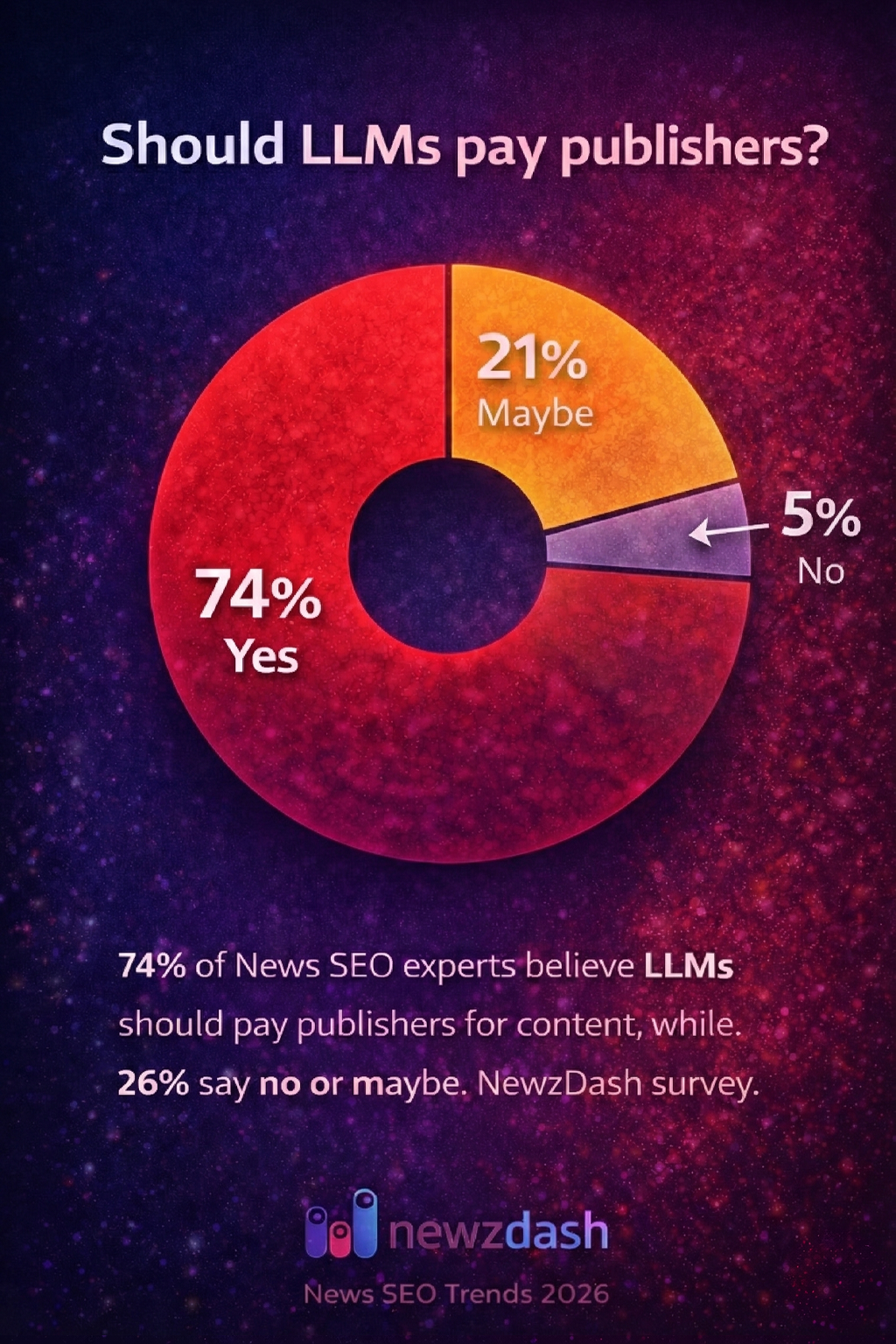
On this question, the industry is far more aligned. While there is debate around how LLMs will impact traffic, there is much stronger agreement that publishers should not be excluded from the value chain when their content is used to train or power AI systems.
In our survey, 74% of News SEO experts believe LLMs should pay publishers, 21% say maybe, and only 5% say no. That level of consensus is notable, especially in an industry that rarely agrees on anything.
Why most experts believe publishers should be compensated
- Publishers create the source material. Original reporting, investigations, expert analysis, and timely news are the foundation that LLMs rely on. Without publishers, the quality of AI answers degrades quickly.
- Attribution alone is not enough. Being cited inside an AI response does not replace lost traffic, revenue, or audience relationships, especially when clicks are inconsistent or optional.
- AI systems are monetized. When AI platforms generate revenue from answers built on publisher content, compensation becomes a business issue, not just an ethical one.
It is worth noting that this 74% figure includes strong support from experts who focused their written predictions on other topics. Industry veterans like Barry Adams, Marshall Simmonds, John Shehata and Harry Clarkson-Bennett all voted "Yes" in the survey data regarding publisher compensation. Their alignment confirms that the demand for payment is not limited to a specific niche of the industry—it is a baseline expectation across the board.
What “paying publishers” could realistically look like
- Licensing agreements. Direct deals that allow LLMs to use publisher content under clear commercial terms.
- Revenue-sharing models. Compensation tied to usage, visibility, or downstream engagement.
- Referral guarantees or incentives. Structured pathways that send meaningful traffic back to original sources.
- Tiered access. Different levels of content access based on partnership terms, freshness, or exclusivity.
Why some experts are still cautious
- Unclear enforcement. Even if compensation models exist, enforcing fair use across platforms and regions will be complex.
- Risk of dependency. Over-reliance on AI licensing revenue could introduce new platform risk, similar to past traffic dependencies.
The practical takeaway
Most experts agree on the principle: publishers deserve compensation when their work powers AI systems. The open question is not if, but how, and on whose terms.
What this means: Publishers should start treating AI compensation as a strategic conversation, involving editorial, legal, product, and revenue teams, rather than waiting for platforms to define the rules.
8) Google Discover in 2026: priority or liability?
 Google Discover is still one of the biggest traffic drivers for many publishers, but it comes with a tradeoff: volatility. That tension shows clearly in the survey results. Most experts still see Discover as a top priority, but a large portion are hesitant to fully commit because the risk is real.
In our survey, 63% of News SEO experts said Discover should remain a top priority, 32% said maybe, and 5% said no. In other words, Discover is still “worth it”, but fewer teams are comfortable building their growth strategy around it.
Why Discover is still a priority
- Discover can move the needle fast. For the right publishers and story types, Discover can still deliver massive reach and scale quickly.
- It rewards strong packaging. Headlines, images, and clear topical signals often make the difference between “flat” and “flying.”
- Discover visibility reinforces brand. Even when clicks fluctuate, repeated exposure builds audience familiarity and loyalty over time.
- It is closely tied to broader trust signals. Strong brands, strong authorship, and consistent topic coverage tend to translate into stronger Discover presence.
Why Discover feels risky in 2026
- Volatility is increasing. Sudden drops happen with limited explanation, and recovery is not always straightforward.
"Over-reliance on Discover traffic has become a deadly danger... don't chase shadows." — Philippe Yonnet
- Dependence is dangerous. Publishers that build the entire operation around Discover often end up at the mercy of the algorithm.
"Newsrooms that pivot their entire operation to Google Discover often find themselves at the whims of the algorithm." — Steven Wilson-Beales
- More competition, fewer guarantees. As more publishers optimize for Discover and visibility fragments across surfaces, wins are harder to sustain.
The practical takeaway
Discover is still a priority, but it should be treated like an accelerator, not the foundation. Top Stories Search status and traffic should always be the priority to maintain a stable Discover Traffic. The healthiest approach is to build Discover strength while actively reducing dependence through diversified traffic and audience channels.
Discover playbook: what to tighten in 2026
- Packaging discipline: Treat headlines and images like performance assets. Test, learn, and build repeatable patterns.
- Entity and topic clarity: Cover your core topics consistently, and strengthen internal linking to establish topical ownership.
- Freshness plus updates: For stories that evolve, update quickly and clearly. Make it obvious what changed.
- Quality signals: Reduce thin rewrites and commodity aggregation. Prioritize originality, sourcing, and credibility.
- Risk management: If Discover is a major driver, set diversification targets and build a plan to hit them.
- Investigate if syndication impacts Google Discover traffic - more to come in the future.
9) Video as the new search engine: YouTube, Shorts, TikTok
Video is no longer just a distribution channel or a branding play. For a growing share of users, video platforms are where discovery starts. YouTube, Shorts, and TikTok increasingly function as search engines, especially for younger audiences and how-to, explainer, and news-adjacent queries.

Across expert responses, one message was consistent: video is not optional anymore. It is becoming a core visibility surface, alongside Search, Discover, and AI answers.
Why video now behaves like search
- User intent is explicit. People open YouTube and TikTok with questions in mind, not just to scroll. Queries like “what happened,” “how does this work,” and “should I care” are increasingly answered in video.
- Platform algorithms reward relevance. Titles, descriptions, captions, engagement signals, and watch time all act as ranking inputs, similar to traditional search signals.
- Video dominates attention. Short-form video, in particular, matches modern consumption habits and performs well in moments when users don’t want to read.
"YouTube is currently the most visible site on the platform... That tells us a lot about where Google thinks user demand is heading." — Nicola Agius
What this means for news publishers
- YouTube is not just social, it’s search. Evergreen explainers, breaking-news context, and topical series can build long-term visibility well beyond the news cycle.
"Video is no longer an ancillary platform; it is a primary news delivery channel." — Greg Jarboe
- Shorts and TikTok are discovery layers. These formats excel at surfacing stories to new audiences and driving follow-up interest across platforms.
- Video supports brand authority. Faces, voices, and repeat formats strengthen trust and recognition in ways text alone cannot.
- Creators economy is the future. According to NewzDash SERP Frequency data, short-form video visibility in Google SERPs for trending news queries in the U.S. has doubled over the past 12 months — from around 4 percent to 8 percent.
Common mistakes publishers still make
- Treating video as a byproduct instead of a primary format
- Publishing without clear titles, context, or searchable descriptions
- Chasing viral trends without tying them back to core topics or beats
- Separating video strategy from SEO and editorial planning
Video playbook: how to approach it in 2026
- Design for search intent. Titles should answer a question or clearly state what the viewer will learn.
- Build topical series. Repeated coverage around core subjects helps platforms understand authority and improves discovery.
- Optimize the metadata. Descriptions, captions, chapters, and thumbnails matter more than many teams realize.
- Think cross-surface. Use video to reinforce Search, Discover, newsletters, and AI visibility, not replace them.
- Measure the right signals. Watch time, retention, and return viewers matter more than raw views.
Bottom line: Video is becoming one of the most durable discovery channels available to publishers. In 2026, treating YouTube, Shorts, and TikTok as search engines, not side projects, will be a competitive advantage.
10) Brand authority, E-E-A-T, entities, and authors as the moat
 As AI answers compress clicks and discovery fragments across platforms, one defensive advantage keeps coming up across expert responses: brand authority. In 2026, trust is not a nice-to-have. It is the moat.
Whether visibility happens in Search, Discover, video platforms, or AI answers, Google and other systems are making the same decision over and over: who should be trusted to represent this topic?
Why brand and E-E-A-T matter more than ever
- AI systems favor known entities. Brands, authors, and organizations with clear identities are easier for machines to understand, rank, and cite.
- Trust compounds across surfaces. Strong authority signals carry from Search to Discover to AI answers, even when the interface changes.
- Commoditized content is easy to replace. Without a clear brand or voice, content becomes interchangeable and more likely to be summarized or ignored.
Authors are becoming visibility assets
Several experts pointed to a renewed emphasis on authorship. In an AI-driven environment, recognizable journalists, subject-matter experts, and consistent bylines help differentiate real reporting from generic synthesis.
"Publishers are becoming talent agencies for journalists." — Jes Scholz
- Named experts create accountability. Clear authorship signals expertise, responsibility, and credibility.
"Focusing on EEAT isn't enough anymore... People want to connect with people more than brands." — Alli Berry
- Author entities help machines connect the dots. Consistent bylines, bios, and topic coverage reinforce who is authoritative on what.
- People (Faces) build trust faster than logos. Especially in video and AI surfaces, people matter.
Entities are the connective tissue
Entity understanding sits underneath everything. Topics, people, organizations, locations, and events form the graph that search engines and LLMs rely on.
- Topical ownership beats isolated rankings. Covering a subject consistently and deeply signals authority more than winning a single keyword.
- Internal linking reinforces expertise. Smart internal links help machines understand context and relationships.
- Structured data supports clarity. Schema does not create authority, but it helps communicate it clearly.
The moat-building playbook
- Strengthen your brand narrative. About pages, editorial standards, and mission statements should clearly communicate who you are and what you stand for.
- Invest in authors. Build robust author pages, highlight expertise, and encourage consistent topic ownership.
- Design for entities. Make it easy for machines to understand your core topics, people, and coverage areas.
- Reduce generic output. Prioritize original reporting, expert analysis, and perspectives that cannot be easily replicated.
Bottom line: In 2026, the strongest defense against AI-driven commoditization is being a known, trusted entity. Brands, authors, and expertise are no longer soft signals. They are infrastructure.
11) Beyond Google: diversification and business models
If there was one area where experts showed the strongest alignment, it was diversification. With traffic becoming less predictable and visibility spreading across platforms, relying on Google alone is no longer a sustainable business strategy.
For many publishers, the question is no longer should we diversify?, but how fast can we do it without breaking the newsroom or the product?
➠ Check 3 Diversification Strategies You Need Right Now!
Why diversification moved to the top of the priority list
- Traffic compression is real. AI answers, Discover volatility, and shifting SERP layouts reduce the number of available clicks.
- Platform risk is no longer hypothetical. Many publishers have already lived through sudden drops tied to algorithm changes.
- Visibility does not equal revenue. Being seen across surfaces does not automatically translate into monetization unless publishers own the relationship with the audience.
Where publishers are diversifying
- Direct audience channels. Newsletters, apps, push notifications, and registered user experiences create repeat engagement that algorithms cannot take away.
- Video-first platforms. YouTube, Shorts, and TikTok drive both discovery and brand loyalty, especially for explainers, recurring formats, and personalities.
- Partnerships and syndication. Strategic distribution deals, platform partnerships, and content licensing extend reach without full dependence on search traffic.
- AI partnerships. Some publishers are already exploring licensing and distribution agreements with AI platforms as an additional revenue stream.
How business models are evolving
- From pageviews to value. Subscription, membership, and hybrid models rely on engagement, loyalty, and trust more than raw traffic volume.
- Advertising diversification. Branded content, sponsorships, and direct deals help reduce reliance on programmatic CPMs.
- Multiple revenue lines. Events, education, data products, and licensing increasingly support the core newsroom.
- Agentic commerce (Machine-to-Machine). The most radical shift is the potential for "bot-to-bot" transactions. Instead of a user hitting a hard paywall, their AI agent negotiates access to specific content via micro-payments in milliseconds.
- The Prediction: Mateusz Mikos warns that premium content must evolve from a "wall" into a structured offer that an agent can understand and purchase.
- The Opportunity: Steven Wilson-Beales describes this as "micropayment heaven," where publishers monetize the answer provided to an LLM, not just the visit to the site.
Diversification that compounds vs diversification that distracts
 Not all diversification is equal. One of the biggest risks publishers face in 2026 is spreading effort across too many channels without a clear compounding effect.
Diversification that compounds
- Builds owned audiences. Newsletters, apps, registered users, and communities that strengthen direct relationships.
- Reinforces brand authority. Video, events, and partnerships that make the publisher more recognizable and trusted over time.
- Connects back to core coverage. Every new channel supports the same topics, beats, and editorial strengths.
- Improves long-term economics. Channels that support subscriptions, memberships, sponsorships, or licensing.
Diversification that distracts
- Chasing every new platform. Launching channels without a clear goal or audience fit.
- One-off experiments. Formats that don’t build repeat behavior or long-term value.
- Disconnected content. Efforts that don’t reinforce core topics, expertise, or brand identity.
- No clear monetization path. Activity that adds workload but not resilience.
Rule of thumb: If a new channel doesn’t strengthen your brand, deepen audience relationships, or improve long-term revenue potential, it’s probably a distraction.
The practical takeaway
Diversification is not about abandoning Google. It is about reducing exposure. The strongest publishers in 2026 will be those that use search as one input, not the entire engine.
What this means: Every publisher should be able to answer one question clearly: What happens to the business if Google traffic drops by 30% tomorrow?
12) Evergreen content in 2026: keep, change, or reduce?
 Evergreen content is not dead, but it is being redefined. As AI answers absorb more explanatory and informational queries, publishers are being forced to rethink which evergreen topics are still worth the investment, and how they should be produced.
In our survey, 58% of experts said publishers should continue investing in evergreen, while 37% said maybe. Very few said no outright. That hesitation is the signal. Evergreen still matters, but not in its old form.
➠ Check Refreshing Evergreen Content: A Comprehensive Guide
➠ Check Are you balancing Consensus vs. Information Gain?
Why evergreen still matters
- Evergreen supports authority. High-quality foundational content helps establish topical ownership and reinforces brand and entity signals across Search, Discover, and AI surfaces.
- It feeds multiple channels. Strong evergreen content can be repurposed into video, newsletters, explainers, and reference material for AI-driven discovery.
- It compounds over time. Unlike breaking news, evergreen content can deliver value long after publication when it is maintained and refreshed correctly.
Why the old evergreen playbook is breaking
- AI answers compress basic explanations. Topics that can be summarized in a paragraph are increasingly satisfied without a click.
"Evergreen content will never function the way it used to, as its role in driving large volumes of traffic has fundamentally changed." — Clara Soteras
- Search demand is shifting. Users are asking fewer “what is” questions and more nuanced, task-based, or contextual queries.
- Maintenance costs add up. Large evergreen libraries require constant updates, and not all pages justify the effort anymore.
- Evergreen shelf life is shrinking. Content that once delivered traffic and rankings for years now often peaks for 6–9 months before losing visibility, forcing teams to refresh or replace it far more frequently.
The Evergreen 2.0 approach
Most experts point toward a middle ground: keep evergreen content, but change how it is selected, structured, and maintained.
- Be selective. Focus on evergreen topics that support core beats, expertise, or revenue, not broad definitions anyone can publish.
- Make it harder to summarize. Add original reporting, proprietary data, expert commentary, tools, timelines, and real-world examples.
- Design for updates. Treat evergreen as a living asset with clear refresh triggers and visible “what changed” signals.
- Structure for reuse. Clear sections, strong internal links, and modular layouts help evergreen content support video, newsletters, and AI citations.
The practical takeaway
Evergreen content should not be produced by default anymore. It should earn its place in the editorial roadmap.
What this means: Keep evergreen content that strengthens authority and compounds value. Change how it’s built and maintained. Reduce anything that exists only to capture commodity search traffic.
13) Biggest challenges facing News SEO teams
 The challenges facing News SEO teams in 2026 are less about tactics and more about operating in a fundamentally different environment. Visibility is fragmented, traffic is compressed, and expectations inside organizations have not always caught up.
Across expert responses, one theme stood out: the hardest part is no longer knowing what to do, but figuring out how to do it sustainably with limited resources, shifting incentives, and constant platform change.
The Existential Crisis: Automate vs. Double Down
Perhaps the most dangerous challenge in 2026 is an internal philosophical split on the future of the SEO team itself. As margins tighten, newsroom leaders face a brutal choice: Do we automate SEO to cut costs, or double down to capture market share?
The "Automation" Argument One camp argues that the traditional "Editorial SEO" role—manually optimizing every article—is no longer financially viable.
- The Prediction: Mateusz Mikos predicts the "Death of Classic Editorial SEO," arguing that "maintaining large Editorial SEO structures is simply burning budget."
- The Strategy: Move SEO ownership to Product and Tech teams. Automate the basics via the CMS and "Agentic Commerce" infrastructure, and reduce headcount dedicated to manual optimization.
The "Investment" Argument The opposing camp argues that cutting SEO talent is a surrender.
- The Prediction: Barry Adams warns that publishers who view traffic declines as inevitable and cut teams are creating a "self-fulfilling prophecy."
- The Strategy: While others pull back, smart publishers should lean in. Search is a zero-sum game; as competitors abandon SEO for AI panic, well-resourced teams will "soak up the traffic" left behind.
The Challenge for Leaders Newsroom leaders must decide if SEO is a product feature (to be automated) or a human skill (to be nurtured). Getting this wrong in 2026 means either burning cash on outdated workflows or losing visibility because no one is steering the ship.
1. Traffic loss without clear replacements
AI answers, evolving SERP layouts, and Discover volatility are reducing click opportunities. For many teams, traffic declines are real, but replacement channels are still maturing.
- Search traffic is harder to predict and harder to recover
- Discover spikes are powerful but unreliable
- AI visibility often lacks consistent referral value
2. Measuring success in a zero-click world
Traditional KPIs like pageviews and rankings no longer tell the full story. Teams are struggling to explain performance when visibility does not translate directly into clicks.
- AI citations without traffic
- Brand exposure without clear attribution
- Inconsistent reporting across platforms
3. Resource constraints inside newsrooms
SEO teams are being asked to do more, across more surfaces, with the same or fewer resources. Supporting Search, Discover, video, AI visibility, and evergreen maintenance stretches even mature teams thin.
- Limited engineering and editorial bandwidth
- Competing priorities across teams
- Difficulty maintaining large content libraries
4. Aligning editorial, product, and SEO
Many experts highlighted internal alignment as a major challenge. SEO recommendations often require changes in editorial workflows, CMS structure, product decisions, and monetization strategy.
- Editorial goals do not always match traffic realities
- Product changes can unintentionally impact visibility
- SEO teams lack authority to influence upstream decisions
5. Keeping up with constant platform change
Between AI Overviews, AI Mode, Discover changes, and evolving video platforms, the pace of change itself has become a challenge.
- Short-lived best practices
- Limited transparency from platforms
- Reactive decision-making replacing long-term planning
The practical takeaway
The biggest challenge in 2026 is not a single algorithm update. It is building resilient workflows that can absorb change without breaking the newsroom.
What this means: News SEO teams need clearer priorities, better cross-team alignment, and metrics that reflect visibility and value, not just clicks.
14) Meet the experts
Below are the experts who contributed to this 2026 News SEO Trends & Predictions report. Each one answered the same set of questions (plus a few additional perspectives), giving us a clear view of where the industry aligns, and where it doesn’t.
John Shehata
Quick take: Visibility is splitting across Search, Discover, video, and AI answers, so publishers must build trust and diversify beyond clicks.
I added my answers and own POV across all sections.
Harry Clarkson-Bennett
Quick take: In 2026, winning visibility is about human connection and differentiation, using video, standout journalism, and smart distribution to cut through crowded platforms where attention is scarce.
Read Harry’s full perspective →
1–3 critical priorities for 2026:
Video. Not because video is doing well in Discover and the SERPs, although that helps. But because it helps humanise brands and people, builds real connections and helps draw in a new audience. It might not be your job directly, but showing the success of video in our platform can help steer the ship too.
Unique, valuable content. For everything you create, think about whether it is adding something to the wider corpus of information out there. Images, data, quotes, expert commentary. Anything you can do to make your content worth indexing and (hopefully) reading is more important than ever. You have to stand out.
Marketing. Think about distribution. Think about how other channels and engagement data affect search and your audience. Where they spend time, how they're influenced et al and push your content far and wide. Work with other teams to make this happen and avoid siloed departments.
The biggest Changes in Google to Prepare for:
The rise of the individual. We aren't just competing with Google, LLMs and other publishers. We're competing against social and video platforms and individual creators, so things are getting busier and busier and the levers we used to be able to pull don't work as well as they did.
As the platforms get busier and attention spans get even worse (if that's possible), you've got to find canny ways to engage with people and be more clickable. You can't forget about quality SEO, but you can't ignore the shifts that are happening.
Alternative platforms or strategies to explore:
Start by figuring out where your audience is and how you can add value. Then think about the type of content most applicable to those platforms and whether it has search value too. Videos, X and Facebook have all shot up in Google Discover because Google is trying to make it a destination.
Apple News has been very effective for some, as have content aggregators like the Drudge Report. So think about areas you can add value to the company commercially. New markets, products, platforms. Nothing should be off limits.
Impact of AI Overviews on News and Newsrooms:
I don't see them being a huge threat to straight news content, but evergreen content will be more difficult to push through. Because the search is dead or dying narrative has spread far and wide, it can be harder to get your commissions pushed through.
In some cases that may not be a bad thing. Straighter stories are on the way out. Explainers need a rebrand. Stories need to be sexy to sell, otherwise you're fighting for attention in an already crowded space.
So I suspect newsrooms double down on quality and uniqueness and stop chasing traffic. But we lose traffic needed to generate revenue and publishing becomes harder to make profitable. So everyone who can will paywall.
Should News Organization Optimize for LLMs?
We should try to figure out ways we can generate more value out of them. I don't think there's much value in real traffic from these platforms, but they're a good proxy for how you are seen across the web. You can use visibility reports to establish your wider sentiment and various inaccuracies on the internet to improve your product marketing.
But, if you can find a way to package how valuable it is for others to feature in your publication (if you feature on these pages, your LLM visibility will increase by x%), you have another product line that ecommerce or SAAS companies may find extremely valuable.
So in a roundabout way, yes.
Barry Adams
Quick take: In 2026, the real risk for publishers is not AI itself but abandoning SEO in panic, because search is now a zero-sum game where disciplined, audience-first SEO will quietly capture the traffic others give up.
Read full perspective →
1–3 critical priorities for 2026:
A key challenge will be maintaining a strong focus on SEO amidst all the noise about AI. Many publishers think search as a channel will disappear, and they are spectacularly wrong. Losing focus on SEO means losing Google traffic, and publishers who are delusional about AI's takeover will interpret their loss of clicks resulting from abandoning SEO as a sign of Google's demise - and a self-fulfilling prophecy is born. Those publishers that continue to support their internal SEO efforts are expected to do well and soak up the traffic that others have abandoned in their AI-instigated panic.
The biggest Changes in Google to Prepare for:
Google's own focus on integrating AI in its results means that the number of clicks Google sends to the web has plateaued. Search is a zero-sum game now, so publishers have to work harder to earn the traffic they have often taken for granted. This means stronger focus on SEO is needed, and publishers who fail at this will leave their readers to be scooped up by competitors.
alternative platforms or strategies to explore:
Multimodal content across multiple platforms and channels will be a key strategy for enduring success. Tap into different platforms' algorithmic recommendation engines - YouTube videos, Substack newsletters, etc.
Impact of AI Overviews on News and Newsrooms:
The lifespan of news articles in Google's ecosystem will be reduced, with AI Overviews supplanting news stories within a few hours. Publishers have a smaller window of opportunity for their SEO.
Should News Organization Optimize for LLMs?
No. LLMs do not drive traffic, so traffic-dependent organisations like news websites would be foolish to optimise for a channel that intends to replace them entirely.
Clara Soteras
Quick take: In 2026, sustainable News SEO is built on community, omnichannel thinking, and journalist-led authority, not chasing traffic sources or short-term spikes.
Read full perspective →
1–3 critical priorities for 2026:
Looking ahead to 2026, publishers face several major SEO challenges that must be prioritized to build sustainable growth. First, developing a truly cross-functional workflow with social, subscriptions, and other departments is essential to create an omnichannel strategy that diversifies monetization rather than obsessing over the exact source of revenue. Second, publishers need to embrace new formats such as vertical video and shorts, which offer fresh opportunities to reach audiences and monetize content beyond traditional articles. Understanding audience needs at every stage (what users want to achieve and how we can best serve them) must guide content creation and product decisions. Finally, and third, publishers should collaborate more closely with creators and strengthen the personal brands of internal journalists, positioning them as authoritative experts. Traffic for traffic’s sake no longer works; the future depends on building a real, loyal community around meaningful journalism.
The biggest Changes in Google to Prepare for:
One of the biggest challenges with Google in 2026 is truly understanding ongoing algorithm changes and adapting to them with agility. Publishers must learn how to work more effectively with Google Discover while also maintaining a strong focus on breaking news, which remains at the core of journalism. At the same time, it is crucial to closely track how AI Overviews and AI Mode continue to evolve, identifying the opportunities these features may still offer for visibility and audience growth. Evergreen content will never function the way it used to, as its role in driving large volumes of traffic has fundamentally changed. However, it will continue to serve as a key pillar for building authority, credibility, and long-term trust. The challenge for publishers is to balance fast, high-impact news coverage with strategic, authoritative evergreen efforts that reinforce expertise in an increasingly AI-mediated search environment.
alternative platforms or strategies to explore:
For me, the answer right now comes down to one very clear word: community. If you have a community, you have a treasure. It’s something publishers should have been building for a long time, but even if you don’t have it yet, it’s never too late to start. Identify your audience, understand their needs, and create a safe environment for them. Offer content and an editorial product they are willing to pay for and truly believe in. You need to become their second home, a place where they feel secure and sense that the people there (both journalists and other readers) share the same interests, the same curiosity, and the same desire to learn and grow.
Impact of AI Overviews on News and Newsrooms:
I believe that, for now, AI Overviews will keep breaking news largely intact, but we still need to monitor how the algorithm evolves, because their visibility has not been consistent since the initial rollout. Although the impact on publishers has been relatively limited so far, this stability is not guaranteed, and the way Google chooses to surface real-time information could shift quickly. At the moment, AI Overviews seem to affect long-tail and informational queries more than fast-paced news coverage, which gives publishers some breathing room. However, if AI Mode becomes the default experience in the browser, the situation could change dramatically. Such a shift could reduce direct traffic, alter user behavior, and disrupt the traditional relationship between audiences and news sites. Publishers will need to stay vigilant, experiment, and be ready to adapt to a search landscape where AI-generated summaries may increasingly sit between journalists and their readers.
Should News Organization Optimize for LLMs?
Yes, I do think we should pay attention to this development and start understanding it, but not with a sense of urgency. The key questions remain: where is the actual business, and where are the clicks? At the moment, this feature contributes only about 0.2% of our traffic, and that is not something that will change overnight. It is important to stay informed, run small tests, and monitor how user behavior evolves, but we shouldn’t divert significant resources from initiatives that currently drive real value. The landscape may shift in the future, and if it does, we will be ready to adapt. For now, though, its impact is minimal, and the priority should remain on strengthening the channels and formats that bring measurable results. Long-term awareness matters, but panic does not. We need to keep perspective, stay strategic, and focus on the areas where growth and opportunity are tangible.
Jes Scholz
Quick take: In 2026, News SEO winners will pair news-cycle dominance with visible AI citations, creator-led video, and journalist authority, optimizing not just for speed and indexing but for standout packaging that earns the click beyond AI summaries.
Read full perspective →
1–3 critical priorities for 2026:
1. Non-AI created videos, especially YouTube, Tiktoks & Reels. Not only do such videos achieve otherwise unattainable visibility on Google Search (especially from knowledge panel and vertical video blocks), Discover and AI Chatbot surfaces. But they also drive revenues if you sign up for their respective content creator revenue programs.
2. In a world where AI is driving content commoditisation to new heights, we’re witnessing a return to the days of newspapers where readers would choose publications based on the authors. Building a journalist's authority is more than having an author profile page. They need recognisable expertise, validated by credentials, awards, a notable social footprint and most importantly, an informed opinion. Publishers are becoming talent agencies for journalists.
3. News cycle dominance. This is achieved by owning both the fast hit and the authoritative follow-up capture the largest compounding traffic and ad yield. Being the fastest involves not only publishing first, but being indexed first. Optimising for speed with technical improvements such as XML sitemaps, RSS feeds, 304 response codes and strong information architecture. Follow-up coverage necessitates editorial playbooks covering priming evergreen content for topical authority, a pre-existing network of experts for commentary and fact check flows. This allows you to produce the highest quality quick follow content to the breaking news story.
The biggest Changes in Google to Prepare for:
More people will read the news in situ in AI Mode as it rolls out wider. But being included in the citations is not enough. You need to be a seen citation, where, as it stands, the top placement is key. And the title and the square image need to grab the user's interest to the point they will click to read more.
alternative platforms or strategies to explore:
As always Google Discover is the obvious one. So too are YouTube, Tiktok and Reels. These are important and should be a focus of any healthy strategy. But what is often underappreciated are the smaller channels, that alone do little, but together can be powerful. Don’t sleep on X and LinkedIn posts, both of which are often featured in Discover. Or News aggregators like Apple News, MSN Partner Hub or Flipboard. Supporting multiple touchpoints earns more digital availability and thus helps to build brand salience.
Impact of AI Overviews on News and Newsrooms:
I don't foresee the presence of AI Overviews significantly changing, as Google is focussed more on AI Mode and Web Guide.
Should News Organization Optimize for LLMs?
Of cause. It's important for brand salience and while click numbers are lower, there is still traffic to be earned. The key is earning a visible, ideally top, citation and working on ensuring the <title> tag, previously over-keyword-optimisied for SERPs, is rewritten to be more engaging. It must give the user a reason to click beyond the commodity content they can read on the LLM. Do you have exclusive video? Images? A expert perspective? Include what makes you standout beyond the information provided by the LLM.
Nicola Agius
Quick take: Video-first discovery and redefining what a “valuable” pageview really is will be critical as AI reduces raw traffic but raises the importance of brand, subscriptions, and meaningful engagement.
Read full perspective →
1–3 critical priorities for 2026:
1. Video: How people consume news is changing, and if we don’t pay attention, we’ll miss a real opportunity. Google is certainly paying attention – just look at how much more video we’re now seeing across both Search and Discover. This isn't accidental. It's also worth noting that YouTube is currently the most visible site on the platform in both the UK and the US. That tells us a lot about where Google thinks user demand is heading. There’s a big opportunity here, so now is a good time to think about what this means for your own site and how you can work more closely with your video teams to make the most of it.
2. Establishing your site's definition of a meaningful PV: With traffic down across publishers globally, it’s worth asking whether pageviews should still be your primary KPI. The reality is that not all PVs carry the same value. Some drive revenue. Some drive subscriptions. And some, frankly, don’t contribute much to your site's longterm growth at all. The key is to identify which pageviews matter most to your business and centre your strategy around those. By doing this, you can show how your work is actively supporting revenue and subscription growth – instead of focusing on raw PVs at a time when overall traffic opportunities simply aren’t what they used to be, for reasons largely outside your control.
The biggest Changes in Google to Prepare for:
We can expect more AI-driven features to roll out from Google next year, and many of them will pose a real threat to publisher traffic. The strongest way to compete isn’t to out-AI the AI — it’s to lean into your brand identity and create the kind of content AI can’t replicate. While AI has its place, people still crave a human voice, human judgment, and human connection.
Publishers should embrace that, not shy away from it.
That said, News SEOs should keep a close eye on the EU’s investigation into Google and its use of publisher content for AI products likes AIOs “without appropriate compensation.” It’s an important development that could shape how AI and publisher relationships evolve in 2026 and beyond.
alternative platforms or strategies to explore:
Google is clearly leaning hard into video. At Search Central Live in Zurich, they even confirmed that they’re prioritising more creator-led content from platforms like YouTube and Instagram. On top of that, they’ve started rolling out social channel integrations — including YouTube — inside the Google Search Console Insights report (though only some users have access so far). The direction of travel couldn’t be clearer. YouTube and TikTok should be considered part of your SEO strategy for 2026. After all, both platforms are effectively video-driven search engines in their own right.
Impact of AI Overviews on News and Newsrooms:
The big question for 2026 is how AI overviews will evolve. Google has already started sending news push notifications that direct users straight to AI Mode. Once there, users aren’t just seeing a summary — they’re served full articles compiled from content published on news sites, including exclusive pieces. This raises a key concern: will AI “overviews” eventually become full-on AI “articles”?
Should News Organization Optimize for LLMs?
"Apologies, but… it depends! The value of LLMs depends entirely on your business model. If your primary KPI is PVs, then the answer is no — LLMs currently drive only around 0.2% of publisher traffic on average. In that case, Bing should be a higher priority than any LLM strategy.
That said, there is an opportunity here — it’s just not website traffic. More than 92% of LLM brand citations come from mentions on news sites. So while LLMs might not drive traffic, those mentions on news sites are very valuable to brands."
Carly Steven
Quick take: News SEO in 2026 is about social search, practical experimentation with LLMs, and doubling down on core SEO fundamentals that power Discover, AI visibility, and real user experience.
Read full perspective →
1–3 critical priorities for 2026:
1) social search optimisation: Google's reign as the front door to the internet is no longer something we can take for granted. Depending on the intent behind their query users are increasingly chosing other platforms to begin their search journey. In 2026 having a 360 view of where readers are engaging with your content and understanding how you can serve their needs on those platforms will be crucial. The new starting point might be ChatGPT - but it could also be Reddit, TikTok or YouTube
2) test and learn with LLMs: the acronym isn't important (SEO, GEO, AEO etc) but getting familiar with how AI answer engines work is the only way to find out if there really is value in optimising for them. There's a lot of noise and some very strong, diverse opnions out there and it can seem overwhelming to know where to start - but that's the crucial first step, just start. Use all the chatbots, run some tests and have the reporting in place before you start so you can accurately assess and feedback to the business on what works and what's just not worth the effort.
3) SEO fundamentals: SEO became a bit of a dirty word in 2025 but next year it should be rehabilitated. Especially for publishers who care about Discover traffic... or AIO/Mode visibility... or citations in LLMs. SEO fundamentals baked into product decisions and editorial best practices have never been more important. At its core, SEO is about creating the best possible user experience and making it as easy as possible for real people to find the highest quality, most helpful content on the web - long live SEO.
The biggest Changes in Google to Prepare for:
The optimist in me hopes that 2026 will be the year Google remembers how important News is to the ecosystem. AI answers are only as good as the content they learn from and if the value exchange breaks down to such an extent that news publishers can no longer afford to create high quality, original content, the whole experince starts to deteriorate. I really hope the recently announced AI partnership deals are the start of more inclusive, broader conversations that benefit all - fair payment for publishers, clear attribution and a richer, deeper pool of diverse sources for readers to angage with.
alternative platforms or strategies to explore:
YouTube - the most cited publisher in AIOs and Google Discover. It's not just about optimsing for visibility on the platform itself (although that is probably where most users will engage), but also for citations and maybe even clicks on these other surfaces. We're starting to get social channel tracking in Search Console and some other third party tools now so what was previously a bit of a black box is now opening up. In 2026 we should be able to implement a proper social search optimisation strategy AND be able to report back to key stakeholders on what's actually working.
Should News Organization Optimize for LLMs?
It really depends what the goal is. I think there are situations where it makes sense - for example in commerce, working with brands - but LLM citations will clearly never subsitute for actual clicks for ad-funded organisations reliant on scale.
Steven Wilson-Beales
Quick take: In 2026, News SEO leaders must balance Discover and AI visibility without becoming dependent on them, go all-in on video optimization, and step up as the internal AI search authority their organizations urgently need.
Read full perspective →
1–3 critical priorities for 2026:
- Google Discover remains a key focus for news publishers and this will become more important when it is rolled out across desktop. Be careful though, newsrooms that pivot their entire operation to Google Discover often find themselves at the whims of the algorithm and forget about building sustainable audiences though distinct, thought-provoking or exclusive content formats.
- In 2026, video, especially vertical video, will become as critical as ever before. We’re already seeming the numbers of creators explode (103 million by 2030 according to Goldman Sachs) so newsrooms need to adapt or die. Whether it’s connecting with external news creators or making stars from your own newsroom, as an SEO, you NEED to be across video optimisation. It’s no longer a side quest!
- Become the AI search visibility ambassador for your company and, by doing so, BOOST your own visibility in your organisation. The C-Suite are looking for experts and you can fill that space which, in turn, will help with getting traction for your campaigns and further investment.
The biggest Changes in Google to Prepare for:
The. big one is going to be the evolution of AI Mode - will it eventually replace organic search OR will there be a hybrid in the form of something like Google’s Web Guide? Whatever the UX, AI visibility optimisation is going to lead more, hence why you should be swatting up on this stuff now before the storm hits.
alternative platforms or strategies to explore:
As John Shehata said at Ness 2025, you need to own your audience across all your brand touchpoints and platforms. You need to be think TikTok, podcasts, newsletters etc. But if we focus on one area which I spoke about in my own YouTube Optimisation Ness session, video consumption is only going to rise and with it the number of creators. That’s a hella lot of video competing with your news brand. My advice would be to work with the news creators - they will help you understand how to crack the algorithm - and then get your staff training programs organised!
Impact of AI Overviews on News and Newsrooms:
I’m afraid AI Overviews will continue to eat into publisher search referral traffic - most notably in areas like Health, Entertainment and Science. We will need to monitor it’s impact on hard news and come together as an industry to object if we see more news queries populated by AI boxes.
Should News Organization Optimize for LLMs?
Undoubtedly. I think we are eventually heading towards a bot-to-bot transactional exchange: You want a video that shows you how to fix that old old synth you’ve just bought? Well, go tell your preferred LLM and they go away armed with a budget and source it from a publisher bot. Yes, it’s going to be micropayment heaven. In that world, websites and apps become less important - but I think that’s a long way off yet, I’m still waiting for the next Virtual Reality evolution!
Optimise by first understanding your current AI Search visibility against competitors, then check your topic authority, then put together a content strategy to reformat current pages and plan for new content. Also invest in content that LLMs will find HARD to scrape like opinion pieces, first person stories, interactive storytelling, video!
Marshall Simmonds
Quick take: In 2026, winning News SEO means being the named source, not just the ranked result, by owning a clear beat, moving fast, and building brand authority that Google is forced to cite.
Read full perspective →
1–3 critical priorities for 2026:
1. Brand authority is a critical ranking signal - Google assess which brands are trustworthy to surface by name. This means brand signals, not just the domain level but topic/vertical level, becomes more important. Know your niche and push to expand Google's categorization of your brand.
2. Own your beat - don't be the third outlet to cover a story with wire-sourced facts. Of course you can and have an obligation to readers to cover breaking news, but if you're the outlet that broke the story, has the expert reporter, or provides unique analysis you become the citation.
3. Speed still matters - be first, be accurate, be authoritative, be unique. Tactically this means LiveBlogs, IndexNow, AMP (sigh), sitemaps, RSS feeds and aggressively pushing for resources to support speed to indexation. Strategically this means, investing in original reporting, expert quotes, unique analysis that differentiates your brand - all in coordination, that makes you citable.
The biggest Changes in Google to Prepare for:
The shift from click-based to citation-based search means publishers must become sources Google has to name, not just summarize.
There are uncomfortable realities all publishers need to accept as Google continues to commoditize news and how it's presented. If Google can summarize information without the need to drive traffic, they will (and they are).This means publishers must shift focus to specific verticals, commentary, analysis, and original reporting with citable value.
alternative platforms or strategies to explore:
Video. Video through player pages, embedded into articles, TikTok, Instagram, YouTube.
Barry Schwartz
Quick take: In 2026, publishers must urgently reduce dependence on core search by building loyal, owned audiences through email, apps, and subscriptions as AI-driven SERPs steadily erode clicks.
Read full perspective →
1–3 critical priorities for 2026:
Build other traffic drivers, outside of core search. Make sure to bolster your email list. Leverage Google Discover traffic while you can, before it goes the way of AI.
The biggest Changes in Google to Prepare for:
AI, for publishers, AI is not just reshaping how journalists do their jobs but it is hurting traffic from Google Search. AI responses are everywhere, leading to fewer clicks and impressions on your web site.
alternative platforms or strategies to explore:
Loyal readership, through email lists, app users, private areas for subscribers...
Impact of AI Overviews on News and Newsrooms:
It will be a negative impact.
Should News Organization Optimize for LLMs?
Yes, they should not block these LLMs. Let them in and see how you can leverage that traffic and brand mentions, if any.
Aleyda Solis
Quick take: 2026 is about becoming a destination brand: go deeper on on-brand topics, expand beyond Google to YouTube and social, then convert that attention into an owned audience through your newsletter.
Read full perspective →
1–3 critical priorities for 2026:
1. Grow your brand to become a destination for your readers, rank and get cited more easily: from your content topics, to your user experience: ask if this is how you want to be recognized.
2. Focus on ""on brand"" topics that are meaningful to target from a topic standpoint and grow your topical authority further
3. Expand your presence beyond Google to reach your audience in other platforms where they're consuming news: YouTube, Instagram, TikTok... and bring them to have a direct engagement with you via your newsletter
The biggest Changes in Google to Prepare for:
The expected full release of Google Discover on Desktop and the likely further integration of AI Mode with news related information.
alternative platforms or strategies to explore:
It depends on where their audience engages, but I would recommend assessing YouTube, Instagram, TikTok and of course, bringing them to their own newsletter for ongoing direct communication that they control.
Impact of AI Overviews on News and Newsrooms:
Rather than AI Overviews, the biggest shift will happen with AI Mode becoming more integrated in the default search experience, where AI Overviews are shown right now and further, not only necessarily for evergreen topics.
Should News Organization Optimize for LLMs?
Yes, they should, but can't consider it a performance only channe and have the same type of expectations than with traditional search with Google so far, but a blend of branding and performance, also measuring its success in visibility, reputation, share of voice, etc.
Philippe Yonnet
Quick take: In 2026, the real risk is not AI replacing traffic, but publishers over-relying on Discover and chasing AI hype instead of building diversified, holistic strategies grounded in brand strength, editorial quality, and community.
Read full perspective →
1–3 critical priorities for 2026:
Over-reliance on Discover traffic has become a deadly danger: it is particularly essential for a news site to diversify its traffic sources, even if this means changing its business model.
Those who hoped that ChatGPT, Perplexity or other generative AI platforms could play a key role in this diversification in 2026 will be disappointed: what lies ahead in the coming months is a landscape in which traditional traffic sources remain strongly predominant: don't chase shadows.
Too many of my clients also have siloed digital strategies. To continue to perform well in 2026, it has become crucial to deploy holistic strategies in which brand strength, reader support, editorial quality, technical quality, added value and the usefulness of what is produced are key factors.
The biggest Changes in Google to Prepare for:
I work mainly in the French market, which has become a very unique market in recent months.
A very French peculiarity is the highly visible presence of ‘Made for Discover’ sites on GD, whose content is entirely generated by AI. We see this in other countries, but in this market, it is done on an industrial scale, and the sites that appear in other European countries are often created by the same French black hats that pollute the Discover feeds in France.
Google seems to be having difficulty preventing these sites from appearing in the feeds, and only removes them after a significant delay.
As a result, Google's recent statements about addressing the problem are not reassuring, as the measures envisaged have not yet solved the problem.
If this were classic spam, one might say that it is no more serious than usual. But these sites spread fake news, including on topics that can have a real negative impact on readers who believe this information. In France, spreading fake news has been a criminal offence for over 140 years, and this exact type of false information falls under another law dating from 2018. But without the cooperation of the digital platforms that relay them, enforcing these laws is slow and tricky.
Publishers need to convince Google this issue is serious
alternative platforms or strategies to explore:
Video content and video platforms in general are a smart way to diversify. Having a large amount of this type of content helps to gain visibility on YouTube and other streaming platforms, as well as on all social media tools.
Don't overlook tools such as newsletters, which are not a thing of the past. Use them as a way to reach your most loyal readers and encourage them to provide feedback on what interests them and what they like about your content.
The same logic applies to all tools that help you build a real community around your media, enabling you to read weak signals and trends and take them into account in your digital and editorial strategy. The digital media landscape is changing rapidly, and you need the information you need to adapt.
Impact of AI Overviews on News and Newsrooms:
The Digital Markets Act has already created significant differences within the European Union for large traffic-generating platforms between their interfaces in the US and Europe.
But, more surprisingly, in France, neither AI Overviews nor AI mode have been deployed by Google. Officially, the reasons are legal (even though, in theory, these reasons could also apply in Spain or Germany). This transforms this market into an ‘island’ that has not been contaminated by AI features in Google.
In practice, therefore, there has been no significant drop in traffic for news sites due to AI Overviews in France, but rather a limited erosion.
Will this French exception last over time? Will Google push its AI features on Google FR from the beginning of 2026? Or will there be a version ‘adapted’ to the requirements of the French regulatory authorities? Only time will tell.
Should News Organization Optimize for LLMs?
Yes, you need to optimise for LLMS, but only after carefully considering the ROI of these projects, which can become very negative if you follow the advice of all the pseudo-experts in AI who hang out on social media.
Essentially, a traditional SEO strategy focused on EEAT does most of the work (especially on the technical aspects). Then you can work on topics such as structuring into ‘chunks’ adapted to Transformer windows, optimising the value of citations, or creating files covering the need for ‘topical breadth’ induced by Query Fan Out behaviours. But don't overdo it, because AI-based tools are evolving rapidly and what works today may no longer be relevant tomorrow.
And given the traffic sent by others (which is fairly symbolic at the moment), these optimisations may only target Google's features and models (or Bing's, at a pinch).
Greg Jarboe
Quick take: AI is forcing News SEO to move beyond rankings, brands that invest in authority, AI-resistant content, and YouTube as a primary news channel will survive and grow in 2026.
Read full perspective →
1–3 critical priorities for 2026:
The year 2026 will be defined by an irreversible shift: Generative AI is changing the discovery and consumption of news. For News SEO professionals focused on traffic and revenue, the strategy must pivot from purely ranking in “10 blue links” to securing authority and owning new channels. I’ve identified three crucial trends for the year ahead:
1. The Triumph of Brand Authority and AI-Resistant Content
As AI models increasingly summarize and synthesize information, traffic expectations must be reset. The winners will be publishers who double down on content that AI cannot easily replicate: original data, in-depth analysis, live coverage, and expert commentary that offers unique insights beyond what a summary can capture. This is an E-E-A-T-first strategy. Publishers must actively track brand visibility to understand where LLMs consider them the definitive expert, which secures citation and prominence within AI Overviews. This focus on quality also provides an internal opportunity to get high-value SEO initiatives prioritized by leveraging the current hype around AI search.
2. YouTube and Short-Form Video: The New Battleground for Breaking News
Video is no longer an ancillary platform; it is a primary news delivery channel. In 2026, YouTube SEO will shift from optimizing evergreen explainers to becoming a critical source of rapid audience acquisition for breaking news. Publishers need to treat their journalists and reporters as on-camera creators, building their individual profiles and fostering off-platform audiences. Optimizing for YouTube's search and recommendation algorithms—which prioritize authority and engagement – requires dedicated investment in high-quality vertical video (for platforms like YouTube Shorts, Instagram Reels, and TikTok) and ensuring that video content is fully transcribed and optimized to capture non-video search queries. Traffic and revenue growth will come from monetizing the direct relationship and engagement built via these video platforms.
3. Local News: The AI-Resilient SEO Opportunity
While national traffic declines, local news publishers have a uniquely resilient opportunity in the age of generative AI. Large Language Models (LLMs) often struggle with real-world, time-sensitive local intent and lack reliable location awareness, making AI Overviews less likely to appear for these queries. Success hinges on a hyperlocal content strategy that goes beyond city-wide pages to cover specific neighborhoods, local events, and community issues. Furthermore, local outlets must explore new mechanisms, such as licensing their unique content to AI companies on a per-crawl basis, to generate meaningful revenue and assert pricing autonomy in 2026. Investing in consistent local data (Google Business Profile accuracy, local reviews) will also remain paramount, as AI models rely on these fundamentals for validation.
The biggest Changes in Google to Prepare for:
News SEOs already know they need to watch AI Overviews like a hawk. According to the Pew Research Center, "Online publishers ... have attributed declining web traffic to these summaries replacing traditional search results, claiming that many users are relying on the summaries instead of following links to the publishers’ websites." But if you drilled down deeper into the data, Pew also said, "The most frequently cited sources in both Google AI summaries and standard search results are Wikipedia, YouTube and Reddit." Now, I've been urging online publishers to embrace YouTube as a complementary news platform for more than 15 years. In 2026, this is mandatory for survival.
alternative platforms or strategies to explore:
YouTube. It's the second largest website after only Google. And the data that supports that is based on visits from computers or phones. It doesn't include watch time on connected TVs (CTVs). And in February 2025, YouTube CEO Neal Mohan said, "People aren’t just watching YouTube on their computers or phones. TV has surpassed mobile and is now the primary device for YouTube viewing in the U.S. (by watch time), and according to Nielsen, YouTube has been #1 in streaming watch time in the U.S. for two years." So, while some might encourage publishers to diversify their portfolio of platforms, I'd share Andrew Carnegie's counter-intuitive advice: "Put all your eggs in one basket and then watch that basket."
Impact of AI Overviews on News and Newsrooms:
It will be bigger than the advent of Yellow Journalism, which was most popular in the late 19th and early 20th centuries, particularly during the period of intense competition between publishers Joseph Pulitzer and William Randolph Hearst in New York City, roughly from 1895 to 1905. This era saw sensationalized reporting and news pushed to extremes to attract readers, with the Spanish-American War being a key event that exemplified these practices.
Should News Organization Optimize for LLMs?
Yes they should. And they should attend NESS 2026 to learn how.
Alli Berry
Quick take: In 2026, winning News SEO means shifting from page-level E-E-A-T to people-led authority, building expert influence, subscribers, and direct audience relationships as zero-click search accelerates..
Read full perspective →
1–3 critical priorities for 2026:
1. Focusing on EEAT isn't enough anymore - you need to be building up your experts' influence and building their presence on social media. People want to connect with people more than brands.
2. If you're struggling to compete in news/Top Stories, you need to continue to build your brand authority through digital PR efforts. I would also try to specialize in the particular niches that Google is associating with your brand and slowly expand from there.
The biggest Changes in Google to Prepare for:
We're moving to a zero-click search reality. We're already seeing it with LLMs, AI Overviews, and AI Mode. To adapt successfully, we're going to need to be very focused on building subscribers and engaging with audience more directly rather than through search. The video and podcast world is getting crowded, but there's still room to grow new shows and build audience if you can come up with a good, unique hook.
alternative platforms or strategies to explore:
Video-focused platforms like YouTube, TikTok, or Instagram are one way to reach new, different audiences. Niche and community platforms could also be a good way for your experts to connect with new, engaged audiences (or you could experiment with advertising there). Partnering with Substackers could also be a powerful way to connect with some new audiences.
Impact of AI Overviews on News and Newsrooms:
We're already seeing declines in traffic; I would expect that to continue. Getting visibility high in the AIO can still lead to more traffic though similar to a featured snippet.
Should News Organization Optimize for LLMs?
Yes; I would focus on building the best Homepage and About page on the internet since those are the pages that increase traffic when LLM visibility increases.
Vahe Arabian
Quick take: In 2026, winning News SEO means unifying SEO and AI, personalizing discovery, and extending optimization beyond Google into social, paywalls, and AI-driven distribution.
Read full perspective →
1–3 critical priorities for 2026:
- Integrate SEO and AI optimization
- Experiment with AI-powered paywall strategies
- Expand SEO to social and non-traditional channels
- Embrace personalization
- Streamline workflows with modern tools
The biggest Changes in Google to Prepare for:
1. SEO + AI Search: A Unified Approach
The NFL’s use of agentic AI in 2025 shows how AI systems can interpret and deliver content rapidly and intelligently, offering a glimpse into the future of AI-assisted content discovery. Publishers who integrate Agentic AI into their workflows now will have a competitive edge in 2026.
2. Optimizing Paywall Content with LLMs
LLMs will revolutionize paywalled content by enabling dynamic adjustments based on user intent. AI-generated previews and targeted access models will balance visibility with monetization, driving subscriptions while optimizing for AI search.
3. Personalization and 'Top Stories'
Google's 'Top Stories' and AI-curated results will prioritize user preferences and history. Create engaging, adaptive content that speaks to individual interests to build loyalty and increase brand search.
alternative platforms or strategies to explore:
1. SEO Beyond Traditional Search Engines
Social media, newsletters, and apps are now search-driven and indexable. With Facebook content discoverable on Google, optimizing for social SEO and Google Discover is critical for expanding reach and brand visibility.
2. Content Creation with MCP Connectors & CMS Platforms
MCP connectors and advanced CMS platforms will standardize multi-channel distribution. Publishers who adopt these tools will lead in making content discoverable and engaging across all touchpoints.
Impact of AI Overviews on News and Newsrooms:
It's stopped mass production of informational commodity content as publishers have experienced ctr and traffic declines. I think key thing to will be evident is the currency of trust and how that will lead into brand searches, personalized results and AI overview prominence for strategic content.
Should News Organization Optimize for LLMs?
Yes, one tactic to conduct is create customised previews based on content formats (for gated or non-gated content) so that it can be distribution ready.
Louisa Frahm
Quick take: In 2026, News SEO becomes audience strategy, winning means optimizing for AI visibility, personalization, and multimodal formats while redefining success beyond clicks.
Read full perspective →
1–3 critical priorities for 2026:
1. Optimize for AI Overviews, chatbots, and zero-click search, to build E-E-A-T with AI platforms and readers
- Techniques like straightforward formatting, FAQ style structuring, bullet points, and lists can make information easier to cite and improve odds of appearing in search results
- Strategic updates also make a difference, as AI bots are known for swapping featured results in and out based off of freshness
- Declining click-through rates are concerning with AIO, but you can still build brand loyalty by appearing in these modules; it's more of a psychological play over time.
2. Recirculate search-friendly content always *in all ways* beyond the first page of Google, to remain relevant and authoritative in timely news windows
- Search (not dead!) remains a powerful trigger to signal what people care about in real-time, but success can't be defined by the first page of Google anymore.
- Apps, newsletters, and social media channels can allow you to connect with your existing audience and draw in new readers where topical trends cross streams.
- SEO strategists must be *audience strategists* in 2026 and beyond, to maximize reach in this new era of search.
3. Diversify SEO content strategy with video, audio, and other formats, to reach readers every way that they consume news
- Traditional articles aren't a universal preference, and we need to adapt our editorial strategies to align with evolving audience behavior.
- Actual SERP pages reflect this shift, showcasing more and more YouTube results, podcast snippets, etc.
- Think strategically about which topics would be best suited for different formats, to create a diverse portfolio of offerings that can showcase your expertise and keep readers engaged.
The biggest Changes in Google to Prepare for:
1. Personalization
- Though Google has always factored in personal elements (EX: location) to influence search results, things took a big turn this year with the introduction of features like Preferred Sources in Top Stories and the follow feature in Google Discover.
- SERPs can look wildly different depending on who is conducting the original search, emphasizing that publishers can't succeed long-term with a one size fits all approach to content strategy.
- In addition to encouraging readers to sign up for search personalization features, publishers should strive to personalize the on-site experience as much as possible, via curated headlines, article suggestions, ads, etc. based off of unique user preferences.
2. Shifting metrics of success
- Declining click-through rates amid the AI boom are very real, and they are forcing us to redefine what makes an article ""successful"" on search.
- Though more traditional publishing metrics like page views still matter, publishers need to start putting a greater emphasis on other authority signals like brand mentions and citations, to properly evaluate overall industry impact.
- E-E-A-T is a more important factor than ever, as readers need legitimate sources they can trust to combat LLM inaccuracies.
3. Emphasis on younger demographics
- Younger audiences have been pivoting away from Google in the past few years, favoring platforms like TikTok for their search needs.
- Google has responded by shifting the look of SERPs to feature more content that can appeal to Gen Z, like Reddit posts, TikTok UGC, etc.
- Publishers should be thinking about how to create more content that can connect with younger readers, to maximize audience engagement during this wave of industry development.
alternative platforms or strategies to explore:
1. Google Discover
- Google Discover syncs with Google's increased emphasis on personalization, making it a positive platform for audience expansion amid AI challenges.
- Google Discover is a great space to experiment with headlines, test out different kinds of content, and brainstorm ways to hook in new readers.
- Google Discover remains a volatile space that should be treated as a supplemental channel vs. a core source of traffic.
2. Reddit
- Since Google and Reddit started their official partnership in 2024, Reddit posts have started to pop up in search results more frequently.
- Reddit is an excellent place for publishers to interact with fans on a more personal level and showcase their E-E-A-T towards trending topics.
- Publishers can expand brand loyalty by conducting AMAs, providing expert intel in relevant subreddits, and responding to fan questions in simple yet impactful ways.
3. YouTube
- Google has been featuring more video results in SERPs during timely windows, and publishers need to be in the mix.
- Breaking news and evergreen video explainers can appeal to a wide range of scenarios and establish a valuable content library that connects with industry developments in multimodal search.
- Publishers should utilize traditional SEO fundamentals in their YouTube strategy, emphasizing trending keywords within short-form and long-form content, to meet a wide array of audience needs.
Impact of AI Overviews on News and Newsrooms:
AI Overviews are unavoidable in 2026. Newsrooms have to play ball with a two-pronged approach: 1. Feed the beast with content it prefers and update articles based off of trending news, to increase odds of appearing in modules. 2. Recirculate search-friendly content beyond the first page of Google, to maintain authority and relevance. AI Overviews are also forcing us to shift how we evaluate performance in 2026, with less emphasis on clicks and more emphasis on overall brand loyalty. Supplemental channels beyond Google will be necessary to keep current readers engaged and find new audiences. To drive it home, SEO strategists must be *audience strategists* in 2026 and beyond.
Should News Organization Optimize for LLMs?
Utility content still matters in 2026! To optimize for LLMs, publishers should zone in on audience questions and provide answers in timely windows. Though LLMs have improved substantially since their initial introduction, their accuracy rates still leave much to be desired. Publishers can deliver verified information when readers need it most. Though the SEO industry is undergoing a massive evolution, certain fundamentals remain the same. If you understand your audience and prioritize their needs, you can still succeed in this era.
Binti Pawa
Quick take: AI-driven search is reshaping traffic, but publishers who focus on quality, trust, and audience-centric metrics, not just pageviews, will build sustainable growth.
Read full perspective →
1–3 critical priorities for 2026:
This year has been a period of rapid change for publishers as the search landscape continues to evolve. With the emergence of AI Overviews, the launch of AI Mode, increased volatility in Google Discover, Google news and the growing influence of large language models, traffic patterns in 2025 have looked very different than in years past.
As AI-driven search continues to expand, having a well-rounded, holistic strategy is more important than ever—one that extends beyond traditional Google Search and prioritizes overall content quality rooted in expertise, trust, and reliability. This approach will be critical for driving growth not only in Google Search, but also across AI-powered discovery experiences. To support this shift, metrics must evolve from simple reporting into strategic levers. While pageviews may still matter for some, there is a growing need to focus on metrics that reflect content quality and conversion, such as lifetime value (LTV), reader return rate (RRR), pages per visit, and similar engagement indicators.
Ultimately, the most effective SEO strategies are those informed by learning and experimentation with your own audience data. Even in the AI era, applying SEO best practices through the lens of what your audience is actively seeking will remain essential.
Mateusz Mikos
Quick take: In 2026, News SEO shifts from chasing clicks to surviving as an infrastructure play, where entity strength, modular content, and machine-to-machine monetization decide who stays visible and profitable.
Read full perspective →
1–3 critical priorities for 2026:
As a former Head of SEO at Ringier Axel Springer Polska and a practitioner who has been repeating for years that ""indexing is a privilege, not a right,"" I see this more clearly in 2026 than ever before.
1. Readiness for ""Agentic Commerce"" (Infrastructure over Paywalls)
The traditional sales funnel in media is dying. In 2026, the user isn't looking for ""offers""; they are tasking their AI assistant with finding reliable information.
The Action: Our premium content cannot be a ""wall"" for AI bots; instead, it must present structured offers that an agent can negotiate.
The Goal: Transitioning to a model of micro-payments and subscriptions concluded ""machine-to-machine."" If your site cannot ""negotiate"" with a shopping bot for a few cents in milliseconds, you are dropping out of the market.
2. Semantic Independence
Visibility in RAG (Retrieval Augmented Generation) systems no longer depends on keywords, but on information structure. AI models do not read articles linearly—they cut them into ""chunks.""
The Action: Every paragraph and content module must defend itself semantically on its own.
The Goal: Building modular content. If a text fragment is ripped out of context and used by AI to construct an answer, it must be 100% understandable and complete. This is the end of ""fluff"" in leads.
3. Technical Foundations and Hybrid Entity Building
I have been saying this for years: to rank, you must exist (be indexed), and in the age of AI, indexing costs are astronomical.
The Action (Technical): Optimization of rendering and structure strictly for cost efficiency.
The Action (Editorial SEO): Technical implementation of Person or NewsMediaOrganization is not enough. This is where Editorial SEO comes in—working at the grassroots level with the newsroom. We must guide journalists by the hand to build their profiles, ensure uniqueness, and deliver ""Information Gain.""
The Goal: Creating ""Ironclad Entities” and a strong personal author brand offers a chance of survival in the results.
The biggest Changes in Google to Prepare for:
Year 2026 is not the time for new meta tags, but for the ultimate stress-test of publisher business models. The biggest change we must prepare for is a total redefinition of the user acquisition cost-to-revenue ratio.
In my assessment, News SEO in 2026 will be defined by three brutal phenomena:
1. The Death of Classic ""Editorial SEO"" and another Team Reductions
What I warned about in 2023 is becoming a reality: a model where a staff of SEO specialists manually ""pushes"" every editorial article is economically unjustified. Facing falling margins, maintaining large Editorial SEO structures is simply burning budget. The Change: News SEO is becoming a purely technical-product process. The role of the ""editorial consultant"" is disappearing. Either the newsroom has automated processes and a CMS that ""does the SEO itself"", or it loses its reason to exist.
2. Google Discover: From ""Golden Ticket"" to ""Russian Roulette""
The Challenge: Basing a media budget on Discover in 2026 is gambling. The algorithm has shifted to a ""Traffic Containment"" model—traffic is kept within the Google ecosystem. Publishers must prepare for the possibility that this tap could be turned off overnight for entire thematic categories. This forces diversification ""as of yesterday,"" because the algorithm takes no prisoners.
3. Google is a Corporation, Not a Library
We must stop deluding ourselves that Google cares about the publishing ecosystem. The Conclusion: The challenge for 2026 isn't ""how to recover traffic,"" but how to optimize the business assuming that traffic is gone. It is time for strategic board-level decisions: cost cutting, pivoting to paid content (paywalls), or doubling down on video and formats that AI doesn't cannibalize (yet).
alternative platforms or strategies to explore:
Finding audiences beyond Google requires a mindset shift and moving from a ""broadcast"" model to a ""concierge"" model.
Here are the key pillars of this transition:
1. Vertical Video as the New Search Engine
For demographics under 35, the search bar is on TikTok or YouTube Shorts, not Google.
Strategy: It’s not about reposting TV clips. Content must be native
Search Lift: YouTube Shorts plays a dual role here—it builds viral reach but is also indexed in traditional Google Search, acting as a bridge to long-form video content.
2. Escape to ""Dark Social"": The Concierge Model
Social media has become noise, so users are retreating to closed groups. In these spaces, the ""broadcast"" model (dumping links) is treated as spam.
Solution: We must become an ""information concierge."" Instead of links, we deliver finished products: bulleted morning briefings or curated audio briefings from editors. We build intimacy and trust, not just reach.
Impact of AI Overviews on News and Newsrooms:
In 2026, AI Overviews have effectively completed the transition of Google from a search engine to an ""Answer Engine,"" finalizing the ""Traffic Containment"" strategy. For newsrooms, the impact is binary and brutal:
1. Brand Awareness over CTR For informational queries, the click is gone. AIO is now a branding tool, not a traffic driver.
Impact: We are shifting our focus from Click-Through Rate (CTR) to ""Citation Share."" The goal is no longer just to get a visit, but to be cited as the primary ""Source of Truth"" in the AI’s answer. Being the source builds the brand trust required for a user to later search for us directly or buy a subscription.
2. The ""Data Provider"" Trap Publishers are now divided into two groups: those who feed the AI for free (hoping for scraps of visibility) and those who block it to protect premium value.
Impact: In 2026, smart newsrooms treat AIO as a ""teaser"" platform. We optimize content to answer the basic question in the snippet (to get the citation) but deliberately structure deep analysis and data behind a paywall or login, forcing the ""agent"" or user to negotiate access for the full picture.
Should News Organization Optimize for LLMs?
The short answer is: Yes, but you must stop thinking of it as ""SEO.""
If you ignore LLMs, you are effectively invisible to the user’s personal assistant. However, the goal has changed. We are not optimizing for clicks—we are optimizing for Attribution
How to do it effectively in 2026?
1. LLMs hate noise. They struggle with complex DOM structures, pop-ups, and heavy JavaScript.
Don't force the AI to scrape your visual website. Provide a ""Data-First"" architecture. Your most valuable content must be easily accessible.
2. Optimize for ""Zero-Shot"" Attribution LLMs are prone to hallucination when data is vague. To be cited, you must be definitive.
Saturate your content with unique entities (names, dates, proprietary data) and connect them logically. Avoid ambiguous language.
Do not optimize for LLMs to get free traffic—that ship has sailed. Optimize for LLMs to ensure your brand remains part of the global knowledge base.
Emily Schwartzberg
Quick take: As search fragments across engines and formats, technical excellence and strong author trust become the foundation for visibility, while community insight is the only way to truly understand audience intent.
Read full perspective →
1–3 critical priorities for 2026:
In 2026, News SEOs will continue to face a more fragmented ecosystem. Readers will be building habits with their specific engine of choice. As a result of a more diversified search landscape, audience intent may become more opaque, especially for publishers lacking advanced tracking tools. This is why building community with readers is critical to understanding the topics that truly resonate. To succeed in this environment, SEOs can:
Focus on technical SEO excellence: The basics of technical SEO will continue to be the prerequisite for visibility. AI engines may have different algorithms, but they rely on the same structural foundations. Without schema, fast page performance, and a clear hierarchical structure, your content will not be visible to the crawlers that could rank or cite it.
Be the trusted source: There is a lot of AI-generated noise on the internet, but there are readers who crave human interaction. Whether through text, audio, or video, highlighting authorship on-site and off-site builds loyal readership and the trust required to be cited by engines.
The biggest Changes in Google to Prepare for:
The biggest shift will be Google and other platforms' evolution into real-time, multimodal engines. We will see a world where search platforms provide information instantly by processing live streams, video, and audio as they happen. AI models are increasingly capable of handling real time news, so speed is of the highest importance as we prepare for that shift. Ensuring articles and videos are published in real time can better position sites for top stories and breaking news.
alternative platforms or strategies to explore:
Instagram recently updated its UI to move “Reels” between the Feed and Direct Messages. This signals to me that Meta is positioning itself against TikTok, creating a domino effect where short-form, vertical video becomes the means to get audiences hooked. Publishers can capitalize on this shift by meeting readers with trusted, expert vertical video on Google Search and Discover, as well as social platforms where habits are forming, like YouTube, X, Instagram, and TikTok.
Impact of AI Overviews on News and Newsrooms:
AI Overviews will answer basic news questions directly on the SERP, which could lead to fewer clicks for publishers for standard news queries. Because the "who, what, and when" will be satisfied instantly by the engine, the bar to earn a click is much higher.
Should News Organization Optimize for LLMs?
Yes, news organizations likely already are, because both LLMs and traditional search engines prioritize technical excellence and helpful content. Even though AI models use different algorithms, they rely on the same structural foundations as traditional search. Beyond a strong technical SEO foundation, I don’t believe that structuring content specifically for LLMs is a sustainable strategy. Instead, just like Google's advice for core updates, I believe SEOs should prioritize “delivering content that's helpful, reliable, and people first.
Justin Bank
Quick take: Agentic and AI search are elevating UGC and creator content as citation sources, making intentional seeding, chunkable formats, and smart creator partnerships essential for news visibility in 2026.
Read full perspective →
1–3 critical priorities for 2026:
The impact of Creator/UGC strategy for citations in agentic results.
AEO forums have plenty of examples of chat citations and links leading to UGC entities sourced from a diverse array of social content. There are links to transcripts of long-form video explainers from professional channels. And there are links to niche facebook groups or subreddits with anonymous commenting. Reddit threads, Quora chats and just about every entity of social conversation they can index and query.
In less than a calendar year, this feature came from basically nowhere to become one of the most dominant search ranking surfaces across engines.
It feels a little bit like when Google started incorporating social signals in universal search back in 2009-2011. They would surface highly engaged tweets with 100+ interactions alongside news stories that (sometimes) led to clumsy results. The feature was discontinued but came back in 2015 with emphasis on tweets from more curated sources.
Agentic search pointing to UGC will certainly be more complex. But product managers at technology companies and users will come to the same conclusion, one way or the other -- quality content is quality content. And, in the aggregate, quality information comes from institutions and credible independent voices.
In 2026, News SEOs should be making sure they are seeding their content on their own branded channels, with intention. And partnering/collabing with the right independent news creators to amplify reach.
The biggest Changes in Google to Prepare for:
The continued march of Gemini across all search surfaces -- except maybe Discover?
alternative platforms or strategies to explore:
The horizontal funnels of creators.
The platforms are all in a bit of a moment of stasis. And you can only push so much through your brand channels as the algorithms spend so much time fighting the rise of slop. Combining positive brand signals through collaborative posting and editing is a key way to break through .. especially if you can mix legacy and emerging brands to show trust signals from different corners of an algorithm and user/base.
Impact of AI Overviews on News and Newsrooms:
More 'chunkable' content to try to get citations in those overviews.
Should News Organization Optimize for LLMs?
Yes. By creating more content in chunkable forms.