World Cup 2026 SEO Playbook: How News Publishers Win Top Stories, Discover, and AI


104 matches, 3 host countries, 7+ SERP surfaces. The playbook for capturing share-of-voice during the biggest publisher cycle this decade.
TL;DR
- World Cup 2026 is the biggest publisher opportunity in any tournament cycle. 104 matches across 39 consecutive matchdays in 3 host countries. Search demand will be sustained, not spiked-and-released as in Qatar 2022.
- Google rebuilt the matchday SERP on June 8 with lock screen score pinning, generative UI in AI Mode, agentic ticket booking, and refreshed Street View for all 16 host stadiums. The Qatar 2022 playbook does not transfer.
- Top Stories is one surface among many. The matchday SERP stacks 7+ layers: schedule card, standings, AI Overview, video carousel, UGC panel, host city site, then Top Stories. Publishers who win across the surface mix capture significantly more share-of-voice than those competing for one slot.
- AI Overviews cite the Movable Middle, not commodity content. Match scores, schedules, and basic stats are grounded from Google's knowledge graph. AI cites publishers for analysis, expert commentary, original interviews, and distinctive synthesis. Position for citation.
- Multilingual SEO is a structural advantage in 2026. Three host countries mean three SERPs (google.com, google.com.mx, google.ca). Publishers with Spanish-language content and proper hreflang compete in markets that English-only publishers cannot reach.
- Live blogs win the LIVE badge in Top Stories. Combine
LiveBlogPostingschema withSportsEventschema and the LIVE badge appears during matches. Live blogs capture the longest engagement of any article format. - Track 5 metrics beyond clicks. Top Stories rank, AI Overview citations, Discover impressions, video carousel ownership, PAA feature ownership, live blog session length, and brand searches. Click-only measurement misses the share-of-voice gains on AI surfaces.
Table of Content:
- 1. Why World Cup 2026 Is a Major Opportunity for News Publishers
- 2. What's New in Google's World Cup 2026 SERP
- 3. How to Win Google Top Stories During World Cup 2026
- 4. How to Win Google Discover During World Cup 2026
- 5. World Cup 2026 SEO for AI Overviews and AI Mode
- 6. Multilingual SEO Strategy for World Cup 2026 (US, Mexico, Canada)
- 7. Live Blogging Strategy for World Cup 2026
- 8. Sports Betting Coverage During World Cup 2026: Editorial Guidelines
- 9. How to Measure World Cup 2026 SEO Performance
- 10. World Cup 2026 SEO Checklist for News Publishers
- 11. Frequently Asked Questions
- 12. Free World Cup 2026 SEO Dashboards from NewzDash
- 13. What the World Cup 2026 SEO data already show
- Bonus 1: Fan content cluster cheat sheet

World Cup 2026 is the biggest editorial opportunity sports news publishers will see for years.
The playbook from Qatar 2022 will not transfer. On June 8, Google rebuilt the matchday SERP: lock screen score pinning, generative UI in AI Mode, agentic ticket booking, and refreshed Street View for all 16 host stadiums. AI Overviews now trigger on a meaningful share of soccer queries. Host city sites carry official tournament backing. Spanish-language queries pull a different SERP entirely.
The publishers who win share-of-voice during the tournament will execute across the full surface mix at the cadence the live event requires: Top Stories, Discover, AI Overviews, live blogs, multilingual hubs, and host country competitors. This playbook covers what changes for 2026, the tactical setup for each surface, and how to measure what matters.
1. Why World Cup 2026 Is a Major Opportunity for News & Sports Publishers

Quick numbers to set the scale:
- 104 matches versus 64 at Qatar 2022 (+62.5%)
- 48 teams versus 32 at Qatar 2022 (+50%)
- 39 days versus 28 at Qatar 2022 (+39%)
- 16 host cities across 3 countries versus 8 in 1 country
- Over 500 million ticket requests during the Random Selection Draw
Three structural shifts matter for SEO:
More matches, more matchdays. Almost every day from June 11 to July 19 has live matches. Forty consecutive matchdays. Demand will be steady through the full window, not the spike-and-release pattern of Qatar 2022.
Three host countries, three SERPs. Same query, different results across google.com, google.com.mx, and google.ca. AI Overviews trigger at different rates. Top Stories surfaces different publishers in each market.
Hispanic-American audiences at their demographic peak. Over 67 million Hispanic Americans, large bilingual base, deep historical Mexican national team following in the U.S. The single largest underserved audience cluster in U.S. World Cup coverage.
Publishers who treat 2026 like Qatar 2022 scaled up will leave significant share-of-voice on the table.
2. What's New in Google's World Cup 2026 SERP

Google's June 8 announcement introduced new tournament features across Search, AI Mode, Maps, and the Gemini app:
- Lock screen score pinning on iOS and Android
- Generative UI in AI Mode for pitch views, formations, and tactical scenarios
- Agentic ticket booking via Ticketmaster, StubHub, SeatGeek, and Vivid Seats
- Refreshed Street View for all 16 host stadiums
- Gemini match briefings delivered through the Gemini app
The matchday SERP is now a layered interface. On mobile, a typical World Cup query stacks: schedule card, standings panel, AI Overview, video carousel, "What people are saying" UGC panel, host city site result, then Top Stories.
The takeaway for publishers: Top Stories remains one of the highest-traffic-driving surfaces for publishers, but it is one surface among many. Publishers who optimize across the full surface mix capture significantly more share-of-voice than those competing for one slot.
3. How to Win Google Top Stories During World Cup 2026

Top Stories drives the biggest matchday traffic spike for news queries. Winning starts with structure and ends with cadence.
Build hub architecture before kickoff:
- One global tournament hub (
/world-cup/). Don't include the year to continue using the same hub in future World Cups. - One hub per host country (
/world-cup/mexico/) - One hub per team your audience cares about
- One hub per host city your audience cares about (
/world-cup-new-jersey/or/world-cup/new-jersey/). Great for local news sites. - For Multilingual sites, repeat the same setup for each language (English, Spanish, French)
Hubs cross-link aggressively. Match articles forward-link to team hubs, team hubs to country hubs, country hubs to the tournament hub.
Headlines: entity-first, time-relevant. Lead with the team, player, or match. Include the matchday date if it is within 48 hours.
- Better: "Argentina vs Brazil World Cup 2026 Live Score and Updates"
- Worse: "What to Watch on July 5 at the World Cup"
Schema discipline. Every article carries NewsArticle schema. Match articles add SportsEvent. Live articles add LiveBlogPosting for the LIVE badge. Validate with Google's Rich Results Test before publish.
Mobile speed under 2.5s LCP. Matchday traffic is overwhelmingly mobile. Slow pages drop out of Top Stories regardless of editorial quality. Dynamic rendering plus CDN caching for hub pages.
Sub-hourly refresh cadence during matches. Goals, substitutions, and VAR decisions each trigger new search demand. Refresh headlines, update lede paragraphs, and republish during the match, not after.
 NewzDash tracks Top Stories ranking on World Cup keyword clusters at sub-hourly cadence throughout the tournament. The free U.S. dashboard, the UK dashboard, and the Canada Dashboard show live SERP movement.
View more World Cup Top Stories (news box) SEO tactics in detail.
4. How to Win Google Discover During World Cup 2026
Discover is the fastest-shifting surface during the tournament. Entity surges are short, sharp, and unforgiving. By the time you see the traffic in Search Console, the moment has passed.

World Cup Content Visibility is rising in Google Discover - data via NewzDash
Speed-to-entity matters more than total volume. When a player or team spikes (red card, debut goal, controversial call), publishers who publish entity-specific content within minutes capture the Discover surge. Wrap-ups an hour later do not.
Image rules are non-negotiable per Google's Discover guidance:
- 1200px wide minimum
max-image-preview:largedirective in the page head- Center the entity (player, team, venue, match moment), not generic stadium shots. No logos as the main image
What to publish during the tournament:
- Goal reaction posts within 5 minutes of a major goal
- Player profile posts within 15 minutes of a star moment
- Controversy explainers within 30 minutes of VAR or referee decisions
- Visual recaps within 1 hour of full time
- Multi-team angles for diaspora audiences
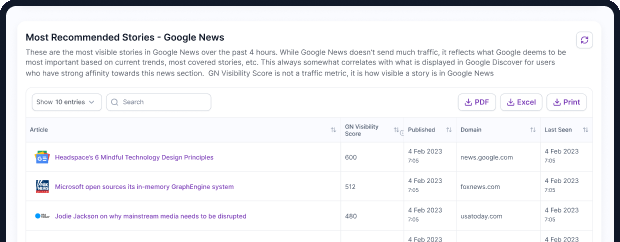
NewzDash tracks the top trending stories in Google Discover in 40+ countries. Analyze the topics, headline patterns and images for best chances to drive traffic.
Google Discover Live Optimization during the event is a great tactic to optimize low-CTR headlines in real-time.

5. World Cup 2026 SEO for AI Overviews and AI Mode

AI Overviews trigger on a meaningful share of World Cup queries. AI Mode wraps the soccer-specific generative experiences. ChatGPT, Perplexity, Gemini, and Claude each have their own answer surfaces for tournament content.
AI Overviews Frequency in Canada and US are almost 4 times its frequency in UK for all trending World Cup news queries.
The Movable Middle. AI systems do not need publishers for commodity data. Scores, schedules, standings, basic stats: Google grounds these from its own knowledge graph. AI Overviews about commodity content do not cite news publishers.
What AI systems do cite: analysis, expert commentary, tactical context, original interviews, distinctive synthesis. This is the Movable Middle. The content category where AI prefers to attribute, because the model cannot generate the original interpretation.
Tactics for AI citation:
- Named, credentialed authors. Every article carries an author byline linked to an author page with credentials, history, and external profile links (LinkedIn, X)
- Specific data plus interpretation. "Argentina has scored 2.4 goals per match since 2022" is more citable than "Argentina has been scoring well"
- Quotes from named experts. Original quotes from coaches, analysts, or former players are highly citable because AI cannot generate them
- Schema for authorship.
Articlewithauthorset to aPersonentity withsameAslinks to verified external profiles
Pete Blackshaw's Answer Economy study tracked AI brand visibility across six major LLMs over 115 prompts in 11 categories. The most relevant finding for publishers: AI doesn't read the rights contract. It reads the internet. FIFA Global Partners with billions in sponsorship spend (Adidas, Coca-Cola, Visa, Hyundai) underperformed in AI visibility versus non-sponsors with stronger editorial presence (Nike, PUMA, EA SPORTS).

The same dynamic applies to news publishers. Exclusive content deals do not translate to AI citation without strong on-site editorial signals.
Our analysis show that AI Overviews will start appearing 5-7 hours from the end of a sporting event, this may change in World Cup.
Track AI citation count alongside Top Stories rank. A publisher with declining clicks but rising AI citations is gaining brand visibility, not losing it. Every publisher should track 3 layers for AI visibility.
6. Multilingual SEO Strategy for World Cup 2026 (US, Mexico, Canada)

For any publisher with multilingual ambitions, World Cup 2026 is the tournament where the investment pays off. Three host countries, three search markets, and the largest bilingual audience cluster in U.S. soccer history.
Multilingual sites have a structural advantage. Without Spanish-language content, the google.com Mexico market is closed. Mexican publishers will dominate that SERP regardless of editorial quality. With Spanish content and proper hreflang, your articles compete on their own merits.
Hreflang is essential. Without it, your Spanish article competes against your English article for the same query. With it, Google serves the right version to the right market.
Local entity coverage in each market. Translation alone is not enough. Local context (Liga MX player histories, USMNT roster details, Canadian Soccer Association coverage) needs to be written locally, not auto-translated.
- U.S.: USMNT, host city logistics (LA, Miami, Atlanta, Seattle), Hispanic-American storylines
- Mexico: El Tri, Liga MX players in the tournament, Estadio Azteca opening match
- Canada: Canadian men's team, BMO Field Toronto, BC Place Vancouver
Hub structure by language. Separate /en/, /es/, /fr/ directories. Each with its own internal linking architecture, country-specific schema, and local context.
7. Live Blogging Strategy for World Cup 2026

NewzDash quickly identifies all major keywords and trends where Google Top Stories display "LIVE" red labels in Top Stories.
Live blogs win the LIVE badge in Top Stories during matches. They also capture session length, multiple page views per session, and the longest engagement of any article format. For matches your audience cares about, live blogs are the highest-leverage content unit.
Schema for the LIVE badge. Combine LiveBlogPosting schema with SportsEvent schema referencing the match. Both must be valid for the LIVE badge to appear. Validate every match's live blog schema 24 hours before kickoff.
Architecture:
- Consider writing a daily live blog for World Cup, create a new URL every day.
- Persistent URL throughout the match (do not republish per goal)
- Paginated post structure (recent at top, archived paginated)
- Real-time WebSocket or polling update mechanism
- Open Graph image updates per major moment
Editorial cadence: every 3 to 5 minutes during play. Every goal, booking, substitution, and controversial decision gets an update post. Tactical observations between events keep engagement live.
War room workflow. The newsroom war room runs as a Slack channel, not a conference room. Real-time alerts for Top Stories ranking drops, AI Overview triggers, headline editing instructions, URL go-live confirmations. During matches, decisions cannot wait for meetings.
Post-match handoff. Within 30 minutes of final whistle, the live blog summary post becomes the canonical match recap. Schema converts from LiveBlogPosting to standard NewsArticle. URL stays the same. Article archives in place.
Create live streaming articles for each game (for publishers streaming the matches or the live commentary online) 4-5 hours ahead of the match, populate with how to watch, and video player featuring some light content enticing the users to bookmark the page for live streaming.
8. Sports Betting Coverage During World Cup 2026: Editorial Guidelines

Sports betting queries will surge during the tournament. Sportsbook content competes for those queries with aggressive SEO and high domain authority. Sports betting query patterns remain consistent: props, odds, predictions, and futures. Track your keywords ahead of time and refresh content daily.
Compliance non-negotiables:
- No predictions framed as guarantees ("locks", "sure wins")
- No targeting of minors in any betting-adjacent content
- Clear state-by-state availability language (38+ U.S. states have legal sports betting)
- Editorial and affiliate content separation (different URL paths, schema, bylines)
- Author credentials on every betting article
- Legal review for any new content template before publication
9. How to Measure World Cup 2026 SEO Performance
Click traffic from Google Search is one metric among several. Publishers measuring only clicks will miss share-of-voice gains on AI surfaces, Discover, and zero-click features.


Track these 5 metrics throughout the tournament:
- Top Stories rank and visibility (traffic share) for priority query clusters (per market)
- AI Overview citation count for World Cup queries
- Discover impressions and CTR at the entity level
- Brand searches for your publication during and after the tournament
Reporting cadence:
- Live for ongoing optimization and identifying missed opportunities
- Daily report during the tournament (matches over by 11pm ET, report by 8am next day)
- Weekly aggregated report for editorial planning
- Post-tournament report 7 days after the final
10. World Cup 2026 SEO Checklist for News Publishers
Operational pre-flight check. Each item is a hard prerequisite, not a nice-to-have.
Before kickoff (June 11):
- Tournament hub live with all team, country, and city sub-hubs
- Schema validated on every hub:
NewsArticle+SportsEvent+BreadcrumbList - Live blog templates built and schema-validated for the LIVE badge
- Editorial calendar mapped to all 104 matches
- Hreflang implemented if multilingual
- Image library prepared (1200px+, no logos, entity-centered, copyright-cleared)
- Author pages live with credentials and
sameAslinks - War room Slack channel staffed with editor, SEO lead, and analytics rep
During the tournament:
- Sub-hourly Top Stories monitoring on priority matches
- Real-time Discover monitoring at the entity level
- Daily AI Overview citation report
- Live blog architecture tested 24 hours before each match
After the tournament:
- Post-tournament share-of-voice report
- Editorial debrief on what worked and what to keep
11. Frequently Asked Questions
How early should publishers start World Cup 2026 SEO planning?
Three to four months before kickoff is the recommended minimum. With June 11 less than a month away, priority is locking hub architecture, schema, and live blog templates first. Editorial calendar mapping comes second.
Should we publish in Spanish if we are an English-only publisher?
Only if you can sustain Spanish content authority post-tournament, and if it aligns with your brand/business revenue goals and audience priorities. One-off translated articles will not rank. Either commit to Spanish as a permanent language or focus on capturing Hispanic-American audiences through English-language Mexican team coverage on google.com.
Will AI Overviews kill our World Cup traffic?
AI Overviews will reduce clicks on commodity queries. AI Overviews may not significantly affect clicks on differentiated queries (analysis, expert commentary, original reporting). Publishers who position for the Movable Middle gain AI citation share even as click share shifts. Publishing fast before AI Overview start appearing for trending news queries is a key in getting as much traffic.
How does NewsArticle schema differ from SportsEvent schema?
NewsArticle describes the article as a journalism artifact (author, date, headline, body). SportsEvent describes the match the article is about (teams, venue, start time, score). Both should be present on match articles.
Should we block AI crawlers from our World Cup content?
Blocking protects exclusive reporting from being grounded by AI systems. It also reduces AI citation visibility for your brand. The safer middle path is page-level policy: block exclusive reporting and original investigation; keep citation pathways open for service journalism, explainers, and authority-building coverage.
12. Free World Cup 2026 SEO Dashboards from NewzDash

NewzDash maintains free real-time World Cup 2026 SEO dashboards for the United States, Canada and the United Kingdom. World Cup 2026 tracking and SEO available in newzdash for 40+ countries. contact us today for more details.
The dashboards track Top Stories ranking, SERP features, AI Overview citations, Discover entity surges, video carousels, and People Also Ask feature ownership for World Cup queries throughout the tournament. Use them as the operational layer behind this playbook.
13. What the World Cup 2026 SEO Data Already Shows
NewzDash tracks 1,284 World Cup keywords in the U.S., 748 in the U.K., and 1,287 in Canada, plus topic-level authority and Discover article-level engagement. Pre-tournament, Top Stories appears on most queries, video carousels on roughly 30%, People Also Ask on 20%, AI Overviews on 5 to 10%, and Live RED Pills on 5 to 10%. On desktop, Top Stories sits further down the SERP than on mobile, so optimization decisions should weight mobile rankings heavier, matchday traffic skews roughly 80% mobile.
Seven patterns are already visible in the data.
1. Three host countries, three different Top Stories races
| Market | #1 | #2 | #3 |
|---|---|---|---|
| United States | espn.com (8.37%) | nytimes.com (7.12%) | yahoo.com (3.88%) |
| United Kingdom | theguardian.com (8.89%) | bbc.co.uk (8.16%) | bbc.com (5.31%) |
| Canada | bbc.com (6.54%) | yahoo.com (3.67%) | espn.com (3.07%) |
A U.S.-only optimization strategy will not transfer. Each market has different incumbent publishers with different authority signals. Multi-market publishers need separate visibility tracking and separate content investments per market.
2. The Guardian dominates Live Blogs in every market
The Live RED Pill (LIVE badge in Top Stories) is dominated by The Guardian across all three markets: 39% visibility in the U.S. with 8 live articles, 55% in the U.K. with 9 articles, and 81% in Canada with 10 articles. The New York Times is consistently the runner-up.
Live blog investment is paying off for The Guardian at a scale most publishers have not matched. LiveBlogPosting schema, persistent URLs, fast update cadence, and dedicated editorial commitment are working. Publishers serious about World Cup live coverage need infrastructure equivalent to The Guardian's, not a stripped-down version.
3. News publishers rarely show up in top 5 most cited domains in AI Overviews
| Market | Top AIO citation sources |
|---|---|
| United States | youtube.com, fifa.com, espn.com, yahoo.com, facebook.com |
| United Kingdom | fifa.com, youtube.com, wikipedia.org, facebook.com |
| Canada | youtube.com, fifa.com, facebook.com, instagram.com, yahoo.com |
YouTube and FIFA.com dominate every market. Wikipedia, Facebook, and Instagram each appear. News publishers other than ESPN and Yahoo are largely absent.
AI Overviews trigger on only 5 to 10% of pre-tournament World Cup queries, a share that will grow as in-match query patterns kick in. The current low trigger rate is not a reason to deprioritize AIO optimization. It is the runway for publishers to position before competition intensifies. The citation winners during the tournament will be the publishers who set up Movable Middle content now. analysis, expert commentary, and original interviews. Not scores, schedules, and basic stats.
4. YouTube owns the Video Carousel
FIFA's official YouTube channel is the #1 video carousel result in every market: 147 videos in the U.S., 156 in the U.K., 156 in Canada. CBS Sports Golazo and other official broadcast affiliates round out the top 5.
Publishers without an active YouTube presence are not competing for this surface at all. For publishers with video, FIFA's official channel is the bar to clear.
5. People Also Ask reveals the underserved questions
The top pre-tournament PAA questions across markets:
- How expensive are World Cup tickets in 2026?
- Will Messi play the 2026 World Cup?
- Where is the 2026 and 2030 World Cup?
- Are fans boycotting the World Cup 2026?
- What is the World Cup Golden Boot?
- Who is predicted to win the World Cup 2026?
- Has Uruguay qualified for the World Cup 2026?
These are content briefs Google is handing publishers for free. Ticket pricing, Messi's participation, controversies, predictions, and award explainers are not the obvious matchday angles. They are the underserved adjacent queries that get clicks during the entire 39-day tournament window.
6. The high-volume keywords are commodity. The wins are in player and squad queries.
NewzDash News Topic Authority data shows where the wins concentrate at the keyword level.
Commodity vs. specialty. The highest-volume queries are saturated: "World Cup 2026" (1.4M), "2026 World Cup" (332K), "World Cup schedule" (290K), "FIFA World Cup" (189K) each have 7 to 9 publishers ranking. High volume, high competition, low margin for new entrants.
The wins are concentrated in player and squad queries with low competitor coverage:
| Keyword | Search volume | Competitors | Top publisher |
|---|---|---|---|
| Lamine Yamal | 200,000 | 4 | theguardian.com (18.2%) |
| England World Cup squad | 50,000 | 3 | nytimes.com (18.6%) |
| Brazil World Cup squad | 50,000 | 3 | bbc.com (18.4%) |
| USMNT World Cup | 4,141 | 4 | foxnews.com (23.3%) |
| USA World Cup roster | 1,374 | 4 | yahoo.com (26.4%) |
| Lionel Messi World Cup | 328 | 4 | usatoday.com (17.1%) |
| Cristiano Ronaldo World Cup | 408 | 4 | theguardian.com (10.7%) |
Lamine Yamal alone has 200,000 searches.
Squad queries trend longest of any category. "World Cup squads" trended for 16 consecutive days. "World Cup 2026 squads" for 12 days. Squad announcements generate 1-2 week sustained search demand, not single-day spikes.
Publisher entity specialization is real and observable. BBC owns most European national team squad queries (Brazil, France, Netherlands, Scotland). The New York Times owns English squad queries and Croatia. Yahoo owns Mexico, Spain, and USA roster queries. The Guardian owns Lamine Yamal, Messi, and Ronaldo narratives. FOX News owns USMNT World Cup. These are entity territories carved out by ongoing coverage, not generic playbook positioning.
7. Discover is video-led and angle-driven, not match-led
NewzDash Entity Analysis tracks article-level Discover engagement. Three patterns dominate the pre-tournament window.
YouTube dominates Discover, not just video carousels. The highest-scoring Discover content for World Cup queries is consistently YouTube videos. Publishers without an active video distribution strategy are missing a second Discover surface beyond the video carousel itself.
Off-tournament angles win the clicks. The top-performing Discover articles pre-tournament cover:
- Labor and strike news (SoFi Stadium workers authorizing strike scored highest)
- Security and policing ramp-ups (Mexico, LA, Houston, Seattle, drone defense)
- Visa and immigration controversies (Iran team visa row, Switzerland striker barred, England and Scotland fans banned from travel)
- Ticket pricing and resale (Financial Times on 180,000 empty seats, Scotland unsold tickets, Dallas parking prices)
- FIFA policy controversies (water bottle ban and reversal)
- Weather and climate (BBC Climate Question podcast on heat risks)
- Local infrastructure (Atlanta MARTA setbacks, Dallas road closures, Mexico City airport renovation)
- Fan culture and international travelers (Freddy from Germany at Waffle House, Cape Verde fans in Pawtucket)
Pure soccer content: match previews, roster news, group analysis, generates modest Discover traction relative to these angles. The pattern aligns with the Movable Middle thesis: Discover rewards synthesis and human-interest context, not scores and schedules.
Local TV stations overperform for host-city stories. KSHB Kansas City, WTOP, KETV Omaha, KIRO 7 Seattle, KFOX, KCRA, WSVN Miami, local TV stations are surfacing on Discover at scale because each host city has its own coverage angles (transit, security, fan culture, local pride). National publishers without local presence cede this surface in most of the 16 U.S. host markets.
Discover scores remain modest pre-tournament, the top-performing article in our tracking scored 8 against a max of 100 (which represents the all-time top Discover article in the market). Discover traction will compound dramatically once matches begin and entity surges accelerate.
The patterns will shift once matches begin
Every dashboard above is pre-tournament. Once kickoff arrives June 11, the data compounds and reshuffles: AI Overview citations expand as match queries spike, Discover entity surges replace scheduled-event interest, Live Pill visibility moves to whoever publishes fastest. The publishers who watch these patterns in real time and adjust within the matchday cycle will capture the share-of-voice that the publishers tracking weekly miss.
Bonus 1: Fan content cluster cheat sheet
Fan questions are not the article's main audience focus. They are demand signals. These are the questions fans will type into Google during the tournament. Cover what fits your beat. Skip what doesn't.
| Cluster | Fan question | Publisher content opportunity |
|---|---|---|
| Tournament logistics | When does the World Cup 2026 start and end? | Key dates explainer, schedule hub (June 11 to July 19) |
| Where is the 2026 World Cup being held? | Host country and host city guide | |
| How does the 48-team format work? | Format primer, bracket explainer | |
| Ticketing & access | How do I get World Cup 2026 tickets? | Ticketing guide (FIFA reports 500M+ ticket requests) |
| How do digital tickets work on match day? | Digital ticket walk-through | |
| Do I need a visa to travel between US, Mexico, and Canada for matches? | Cross-border travel guide | |
| Venues & host cities | Where is the World Cup 2026 final being played? | Final venue guide (MetLife Stadium, East Rutherford NJ, July 19) |
| Where is the opening match? | Opening match guide (Estadio Azteca, Mexico City, June 11) | |
| Which city is hosting the most matches? | Host city ranking (Arlington's AT&T Stadium hosts 9, the most; Atlanta hosts 8 including semifinal) | |
| Why is the stadium called "Mercedes-Benz" but "Atlanta Stadium" on tickets? | Naming explainer (FIFA strips corporate names) | |
| What can fans bring into stadiums? | Matchday rules checklist per venue | |
| Where are the fan zones in each host city? | Local fan festival guide | |
| Broadcasting & viewing | How can I watch the World Cup 2026? | Dedicated "how to watch" page, BroadcastEvent schema |
| What time does the match start in my time zone? | Match start time tool with time zone converter | |
| Teams & players | What teams qualified for the World Cup 2026? | Hub page, team profile pages |
| Who is injured or suspended? | Live team news and lineup page | |
| Who are the favorites to win? | Power rankings, expert picks | |
| Format & rules | What are the new offside and VAR rules for 2026? | Rules explainer |
| Culture & experience | Who are the World Cup 2026 mascots? | Mascot explainer (Maple the Canadian moose, Zayu the Mexican jaguar, Clutch the bald eagle) |
| Will alcohol be sold at host stadiums? | Stadium-by-stadium policy guide |
If fans ask it repeatedly, decide where it belongs before matchday. Some questions deserve evergreen explainers. Some deserve live updates. Some deserve local guides. Some deserve a short FAQ answer inside the hub.
Use the NewzDash PAA - Top Sites widget during the tournament to capture which fan questions are actually being asked on tracked World Cup queries. The cheat sheet above is the baseline. The widget surfaces what's trending in real time.